
Who this guide is for
- Stadium and arena owners planning a recurring operations and condition review cycle
- Clubs and venue operators preparing to structure an annual look-back with their teams
- Municipalities and public bodies responsible for community or civic sports venues
- Schools, universities and colleges reviewing owned or shared stadium facilities
- Developers and project teams handing a venue into an operational review rhythm
- Facility managers preparing agendas, registers and documents for a review meeting
Planning diagram
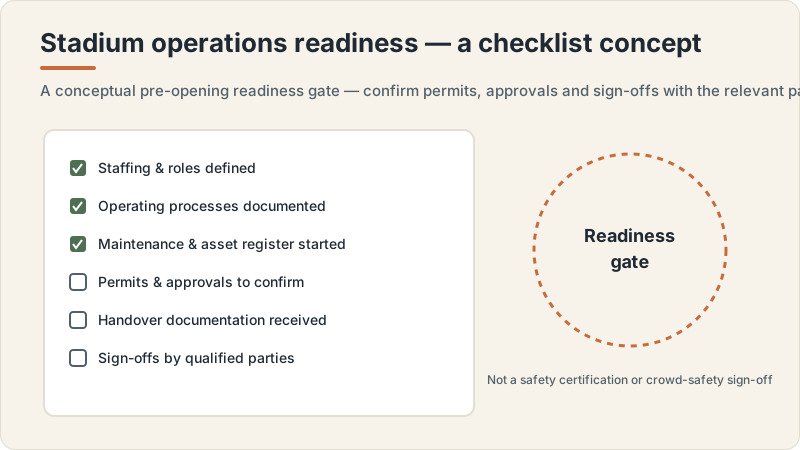
Stadium operations readiness concept
Conceptual editorial diagram — not a construction drawing, specification, to-scale plan or proof of a real project. It is not engineering, structural, fire/life-safety, crowd-safety or accessibility-compliance guidance. Capacities, dimensions, standards, requirements and costs vary by facility type, audience, site, use case and governing body, and are confirmed with qualified professionals, relevant authorities and governing bodies. Build Design Hub does not design, build, inspect, certify, recommend or match anyone.
What this guide helps you prepare
This guide helps you prepare the structure of an annual stadium review rather than carry one out to a technical conclusion. The aim is to arrive at your review meeting with a clear agenda, an organised set of records, a defined list of who should attend and a shortlist of questions that need qualified answers. Preparing this way means the review time is spent discussing evidence and decisions instead of hunting for documents or debating what the review should even cover. It also helps you separate what you can reasonably observe and log internally from what genuinely needs professional judgement, so nothing important is either skipped or wrongly assumed to be settled.
It is important to be clear about the boundary of what a preparation framework can do. This guide will not tell you how often a review must occur, what any element must achieve, whether any part of the venue meets a standard, or how to interpret an inspection, certification, warranty or code obligation. Those determinations depend on your specific facility, its use, its governing body and the professionals engaged on it, and they must be confirmed with those people and the relevant authorities. Think of the review you are preparing for as a coordination and decision-making exercise, with the framework here helping you organise inputs and questions rather than supplying answers or approvals.
- Draft an agenda that names the themes the review will cover for your venue and use case
- Assemble the records, logs and prior-year notes you will bring to the discussion
- List who should be invited and what perspective each attendee is expected to represent
- Separate items you can observe and record internally from items needing professional judgement
- Note last year's actions and outcomes so progress and gaps are visible at the meeting
- Prepare a shortlist of open questions to route to appropriately qualified professionals
Choosing the review scope and themes to examine
A useful annual review starts by deciding, in advance, which themes it will and will not cover, so the discussion stays focused and repeatable year to year. Common themes to consider gathering information about include the physical condition of the venue as observed and logged, the operations and event-readiness experience over the year, maintenance activity and any deferred items, records and documentation completeness, supplier and contractor performance from the owner's perspective, and any changes in use, ownership or governing expectations. Framing each theme as an information-gathering area rather than a verdict keeps the review honest: the goal is to surface what is known, what is uncertain and what needs a qualified opinion, not to declare a component compliant or a structure sound.
Scope also means deciding what is deliberately out of scope for an internal review and instead belongs with professionals. Anything touching structural adequacy, spectator or crowd safety, evacuation planning, fire and life safety, accessibility obligations, or the interpretation of inspections, certifications and codes sits outside a self-directed review and should be flagged for qualified specialists and the relevant authorities. Requirements and thresholds in every one of these areas vary by location, facility type, use case, governing body, owner, site, authority, professional team and project scope; confirm them with qualified professionals rather than assuming last year's position still holds. Writing the out-of-scope list explicitly protects the review from drifting into judgements it is not equipped to make.
- Which themes will this review cover, and which are explicitly out of scope for an internal look?
- How will condition observations be recorded without implying a structural or safety verdict?
- What operational and event-readiness experience from the year should be documented and discussed?
- Which items must be flagged for qualified specialists rather than resolved in the meeting?
- Have any changes in use, ownership, occupancy or governing expectations occurred since last year?
- Where has last year's information become stale and needs confirmation with professionals or authorities?
Assembling participants, roles and review inputs
An annual review works better when the right perspectives are in the room and each participant knows why they are there. Depending on the venue, this might include the owner or their representative, the operator or facility manager, people responsible for maintenance and grounds, and a documentation or records holder; for some themes, the owner may decide to invite qualified professionals or ask questions of them separately afterward. The point of mapping participants in advance is to make sure no important perspective is missing and that responsibility for each theme and each follow-up action is clearly owned, rather than left as a shared assumption that no one acts on.
Alongside people, prepare the inputs the review will rely on. This typically means the prior review notes and their action list, maintenance and activity logs kept during the year, records and documentation relevant to each theme, and any correspondence with suppliers, contractors, professionals or authorities. Gathering these before the meeting turns the review into an evidence-based discussion and makes it easier to see where records are incomplete or where a topic has drifted without being noticed. Build Design Hub does not introduce, broker, verify or match any of the professionals, suppliers or contractors referenced in these inputs; sourcing and engaging them remains the owner's responsibility with appropriately qualified people.
- Who represents the owner, operator, maintenance function and records-holding role at the review?
- For which themes might qualified professionals need to be present or consulted separately?
- Which prior-year notes, logs and action items should be circulated before the meeting?
- What documentation and correspondence relate to each theme, and where is it currently held?
- Who will own each follow-up action, and how will progress be tracked to the next cycle?
- Which questions are better routed to professionals or authorities in writing after the review?
Planning questions before speaking with professionals
Before you involve qualified professionals, it helps to organise your own thinking so their time is spent on judgement rather than fact-finding. Work through what you already know about the venue and its year, where your records are strong and where they are thin, and which of your review themes have raised questions you cannot answer internally. This preparation lets you approach professionals with a clear, prioritised brief instead of an open-ended request, and it helps you recognise the difference between something you can reasonably log yourself and something that genuinely requires a specialist's assessment or an authority's confirmation.
As you prepare, resist the temptation to treat any figure, interval, threshold or obligation as settled just because it appeared in a previous review. Capacities, dimensions, review frequencies, maintenance intervals, and compliance obligations all vary by location, facility type, use case, governing body, owner, site, authority, professional team and project scope, and they can change between cycles. Note every such point as a question to confirm rather than a fact to reuse. The stronger and more specific your preparation, the more useful the eventual conversation with qualified professionals will be.
- What do we actually know about the venue's condition and operation this year, and how do we know it?
- Which review themes have raised questions we cannot answer with internal information?
- Where are our records incomplete, and what would we need to gather before asking for help?
- Which figures or obligations from last year are we assuming rather than confirming this year?
- What is the priority order of the questions we want qualified professionals to address?
- Which items are we treating as internal observations versus matters needing a specialist's judgement?
Questions for qualified professionals
When you engage qualified professionals, use your prepared brief to ask focused questions and to confirm anything you have been carrying forward as an assumption. Because this guide does not and cannot state requirements, standards, intervals, capacities or obligations for your specific venue, the most valuable questions are those that ask the professional to establish what actually applies to your facility, its use and its governing context, and to explain what evidence or process supports their view. Bring your records and your list of uncertain items so the discussion can be grounded in your real situation rather than in general expectations.
It is equally important to ask professionals to define the boundaries of their own scope, so you understand which questions still need another specialist or an authority. Structural, safety, fire and life-safety, accessibility, inspection, certification, warranty and code matters are frequently governed by different parties, and clarity about who is responsible for what prevents dangerous gaps between disciplines. Build Design Hub does not select, rank, verify or match the professionals you consult; use these prompts to have a more informed conversation with the qualified people you engage for your project.
- Which review requirements, frequencies or obligations actually apply to this facility, and how are they determined?
- Which themes on our review sit within your scope, and which need a different specialist or authority?
- What would you need from us to assess the items we have flagged as uncertain?
- How should we interpret or act on any inspection, certification or warranty documentation we hold?
- What records or evidence should we be maintaining to support future reviews and professional assessments?
- Which of our carried-forward assumptions should be reconfirmed, and by whom, this cycle?
What this does not replace
This is an educational planning resource only. It is not a stadium construction manual and not structural, architectural, seating or stand engineering, crowd-safety, crowd-flow, evacuation, fire or life-safety, or accessibility-compliance advice, and it is not permit, zoning, inspection, certification, legal, tax, insurance or procurement advice. It does not design, build, engineer, specify, certify, inspect or approve anything, gives no capacities, dimensions, loads, revenue, ROI or costs, and offers no warranty interpretation or estimate. Requirements, standards, capacities and costs vary by location, facility type, use case, governing body, owner, site, authority, professional team and project scope, and are confirmed with qualified professionals, relevant authorities and governing bodies.
Build Design Hub does not design, build, engineer, inspect, certify, recommend, rank, verify, introduce, broker or match suppliers, contractors, consultants or professionals, and HELPERG LLC is publisher/operator only. Use this resource to prepare your own thinking and briefs, then have qualified professionals you engage directly review your project. Decisions about design, engineering, structure, crowd safety, fire and life safety, accessibility, compliance, capacity, procurement and cost must rest on those professionals, the relevant authorities and the governing bodies for your sport and location.
- Not a stadium construction manual and not structural, architectural or seating/stand engineering
- Not crowd-safety, crowd-flow, evacuation, fire/life-safety or accessibility-compliance advice
- Not permit/zoning, inspection, certification, warranty-interpretation, legal, tax, insurance or procurement advice
- Not a supplier, contractor, consultant or professional recommendation, ranking, directory or matching service
- Not an estimate and gives no capacity, dimension, revenue, ROI or cost figures — requirements and costs vary
- Qualified professional review is required before any stadium project decision
Annual stadium review preparation worksheet
- 1Record the review's intended themes and write an explicit list of what is out of scope for an internal look
- 2Gather the prior-year review notes and their action list, and note which actions are open, closed or stalled
- 3Collect maintenance and activity logs kept during the year for each theme the review will discuss
- 4Assemble documentation and correspondence relevant to each theme, and note where each item is held
- 5List every participant to invite and record which perspective and responsibility each represents
- 6Note which themes may need qualified professionals present or consulted separately afterward
- 7Write down what you actually know about the venue's condition and operation, and how you know it
- 8Flag every item touching structure, safety, fire/life-safety, accessibility, inspection or certification for specialists
- 9Mark each figure, interval, threshold or obligation carried forward as a question to reconfirm, not a fact
- 10Identify where your records are incomplete and what you would need to gather before asking professionals
- 11Prioritise the open questions you want qualified professionals or authorities to address
- 12Assign an owner to each anticipated follow-up action and a way to track it to the next cycle
- 13Note any changes in use, ownership, occupancy or governing expectations since the last review
- 14Prepare a short brief for professionals summarising your situation, records and uncertain items
Common mistakes to avoid
- Treating last year's capacities, intervals, thresholds or obligations as fixed facts instead of reconfirming them each cycle
- Assuming a review requirement or frequency applies without checking it against your facility, use case, governing body and authorities
- Letting the review drift into structural, safety, fire or accessibility judgements that belong with qualified specialists
- Recording condition observations as verdicts (compliant, sound, safe) rather than as logged information for professional assessment
- Skipping professional review of flagged items because the venue 'looked the same as last year'
- Inviting the wrong participants or leaving each theme's responsibility as a shared assumption that no one owns
- Arriving without prior-year notes, logs or documentation, so the meeting becomes fact-finding instead of decision-making
- Assuming Build Design Hub or any resource can supply, verify or match the professionals, suppliers or contractors the review references
When to involve a professional
- When any review item touches structural adequacy, spectator or crowd safety, evacuation, or fire and life safety
- When accessibility obligations, inspections, certifications, warranties or code and permit matters need interpretation
- When a carried-forward figure, interval, capacity or obligation needs to be confirmed for your specific facility
- When a change in use, ownership, occupancy or governing expectation may alter what the venue must satisfy
- When your internal records cannot answer a review question and a specialist's assessment is required
- When responsibilities span multiple disciplines and you need clarity on who owns each element and any gaps between them
Frequently asked questions
Questions readers ask about this topic
Does Build Design Hub carry out the stadium review, or design, inspect or certify the venue for me?
No. Build Design Hub is an educational publisher operated by HELPERG LLC. It does not design, build, engineer, inspect, certify, recommend, rank, verify, introduce, broker or match suppliers, contractors, consultants or professionals, and it does not state any capacity, dimension, cost, interval, requirement or standard as a fact. This guide only helps you prepare a review's structure, records and questions; the review itself and any technical or compliance judgement must be carried out and confirmed with appropriately qualified professionals and the relevant authorities.
How often should an annual stadium review actually happen, and what must it cover?
This guide cannot state a required frequency or mandatory scope, because those vary by location, facility type, use case, governing body, owner, site, authority, professional team and project scope. The word 'annual' here describes a common planning rhythm, not a rule for your venue. Confirm the appropriate frequency and coverage for your facility with qualified professionals and the relevant authorities and governing bodies.
Can I reuse the capacities, intervals and obligations recorded in last year's review?
Treat them as questions to reconfirm rather than facts to reuse. Capacities, dimensions, review frequencies, maintenance intervals and compliance obligations can change between cycles and depend on your specific facility and its governing context. Note each carried-forward figure or obligation as an item to confirm with qualified professionals or the relevant authority during the current review.
How do I decide what to handle internally versus taking to a professional?
As a preparation habit, separate what you can reasonably observe and log (such as recording that something occurred or that a document exists) from anything requiring specialist judgement or an authority's confirmation. Items touching structure, safety, fire and life safety, accessibility, inspections, certifications, warranties or codes generally belong with qualified professionals. When in doubt, flag the item for professional review rather than resolving it internally.
Keep reading