
Who this guide is for
- Stadium and venue owners planning long-term upkeep and reinvestment conversations
- Sports clubs and event operators preparing to brief facility and maintenance teams
- Municipalities and public bodies stewarding community sports venues
- Schools, colleges and universities planning maintenance for their sports facilities
- Developers and project teams preparing operations and handover documentation
- Facility managers organising maintenance scope, registers and professional questions
Planning diagram
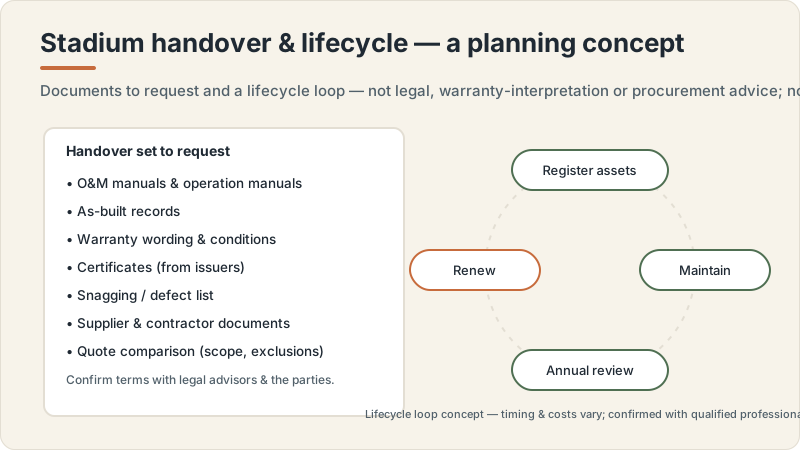
Stadium handover and lifecycle concept
Conceptual editorial diagram — not a construction drawing, specification, to-scale plan or proof of a real project. It is not engineering, structural, fire/life-safety, crowd-safety or accessibility-compliance guidance. Capacities, dimensions, standards, requirements and costs vary by facility type, audience, site, use case and governing body, and are confirmed with qualified professionals, relevant authorities and governing bodies. Build Design Hub does not design, build, inspect, certify, recommend or match anyone.
What this guide helps you prepare
This guide helps you assemble the raw material for a considered stadium maintenance planning conversation: a description of your facility and its assets, a record of how it is used across event and non-event days, the questions you still cannot answer, and the gaps you want qualified professionals and relevant authorities to fill. Rather than telling you what maintenance to perform, it helps you build a brief that makes those professional conversations sharper, so that scope, responsibilities, priorities and lifecycle thinking can be discussed against your actual site instead of generic assumptions.
It also helps you think about maintenance as a lifecycle discipline rather than a one-off reaction to breakdowns. That means preparing to discuss how assets age, how usage intensity changes what upkeep may involve, how information should pass from construction handover into ongoing operations, and how you might structure comparable questions when approaching different suppliers or contractors. The aim is preparation and clarity, not answers: every activity, frequency, threshold and responsibility should be confirmed with qualified professionals, because requirements vary by location, facility type, use case, governing body, owner, site, authority, professional team and project scope.
- Draft a plain-language description of your facility, its main assets and how each is used
- Record open questions you want to put to qualified professionals rather than answering yourself
- Capture how event days, training, community use and closed periods change demands on the venue
- Note where handover documentation, drawings or manuals exist, are incomplete or are missing
- Prepare a consistent question set so different suppliers or contractors can be compared like-for-like
- Identify which decisions clearly need a qualified professional, an authority or a governing body to confirm
Thinking about the stadium as a portfolio of lifecycle assets
A stadium is rarely one asset; it is a portfolio of very different systems with very different ageing patterns, from the playing surface and pitch systems to seating areas, roofing and canopies, mechanical and electrical services, lighting, drainage, catering and hospitality spaces, technology and communications, and the external estate. Maintenance planning is easier to discuss when you have listed these assets and can describe, in your own words, what each one is, roughly how old it is, and how heavily it is used. This is a description exercise for your brief, not a technical assessment: condition, remaining life, risk and priority are all matters to confirm with qualified professionals who can inspect the specific installation.
Lifecycle thinking means preparing to ask how each asset group is expected to behave over time and what information would help you plan for that, rather than assuming a fixed lifespan or replacement point. Different assets may sit on different horizons, may interact with one another, and may be affected by how intensively the venue is used, so a register that simply captures what you have and what you know is a strong starting point. Resist the temptation to write down assumed lifespans, replacement years, capacities or performance figures as facts; instead, record them as questions and leave the answers to professional judgement against your site.
- List the major asset groups at your facility and give each a plain description
- Note approximate age or installation period where you know it, and mark it uncertain where you do not
- Record how heavily each asset group is used and whether that has changed over time
- Capture any known concerns, past issues or works without drawing your own conclusions about severity
- Frame expected lifespan, remaining life and replacement timing as questions for professionals, not stated facts
- Flag assets where you have little or no documentation so professionals know where information is thin
Connecting handover, operations and ongoing upkeep
Maintenance planning benefits enormously from a clear line of sight between how a facility was built or last refurbished, how it is operated day to day, and how it is maintained over its life. Much of that line of sight lives in handover documentation: drawings, manuals, asset registers, warranties, commissioning records and operating information. Preparing to discuss maintenance means checking what handover material you actually hold, what is missing, and what you would need to request or reconstruct. This guide does not interpret warranties, certificates or compliance obligations for you, and it makes no claim about what any document requires; those are matters for qualified professionals and the relevant authorities.
It also helps to think about how operations and maintenance information should flow between the people who run events, the people who look after the building, and the professionals who advise on it. Preparing questions about roles, responsibilities, record-keeping and how issues are reported and tracked can make later conversations far more productive. The goal is to arrive at professional discussions with an honest picture of what you know and do not know, so that scope and responsibilities can be defined against your real situation rather than an idealised one, and so nothing important is assumed to be someone else's job by default.
- Inventory the handover and operating documents you hold, and list what appears to be missing
- Note where drawings, manuals or asset data are out of date, unclear or inconsistent
- Prepare questions about how maintenance responsibilities are divided between in-house teams and external parties
- Record how faults, defects and requests are currently reported and tracked, if at all
- Ask professionals how operations and maintenance information should be kept current over time
- Treat warranty, certificate and compliance interpretation as questions for qualified professionals and authorities
Planning questions before speaking with professionals
Before you approach qualified professionals, it helps to answer the questions that only you and your organisation can answer, so that professional time is spent on genuine expertise rather than basic fact-finding. These are questions about your objectives, your constraints, your usage patterns, your appetite for planned versus reactive work, and the information you already hold. Writing these down turns a vague sense that maintenance needs attention into a structured brief that a professional can respond to, and it helps you notice where your own assumptions are actually questions in disguise.
Work through these prompts as a self-assessment, capturing answers where you have them and marking clearly where you do not. Nothing here should be treated as a requirement or a standard; the point is to surface your context and your open questions. Where a prompt touches on anything technical, safety-related, regulatory or contractual, record it as something to confirm, because requirements vary by location, facility type, use case, governing body, owner, site, authority, professional team and project scope, and only qualified professionals can assess your specific facility.
- What are our main objectives for this facility over the coming years, and how does maintenance support them?
- Which assets or areas do we already worry about, and why, in plain terms?
- How is the venue used across event days, training, community access and closed periods?
- What documentation, budgets and internal capacity do we realistically have to work with?
- Where are we currently guessing about condition, cost, life or responsibility, and should stop guessing?
- Which questions clearly need a qualified professional, authority or governing body rather than an internal answer?
Questions for qualified professionals
Once your brief is assembled, this section helps you prepare the questions to put to the qualified professionals, suppliers, contractors, authorities and governing bodies who can give binding guidance for your specific facility. Good questions ask professionals to assess, explain and advise rather than asking this guide or your own team to assume. They also help you compare responses fairly: if you ask different parties the same structured questions about scope, method, responsibilities and how they would document their work, you can weigh their answers on a like-for-like basis without this guide recommending, ranking or matching anyone.
Frame every question so that the professional supplies the substance. Ask what is involved, what they would inspect or assess, what they would need from you, how they would define scope and boundaries, and how their advice relates to any applicable authorities or governing bodies. Avoid stating figures, intervals, capacities or standards in your questions as if they were settled; instead, ask the professional to confirm them for your site. This keeps responsibility where it belongs and gives you comparable, defensible information to plan around.
- How would you assess the condition and remaining life of these asset groups at our facility?
- What would your scope include and exclude, and where do responsibilities sit between us and you?
- What information, access or documentation would you need from us to advise properly?
- How does your advice relate to the relevant authorities, governing bodies and any applicable requirements?
- How would you record and hand back findings, and how should we keep that information current?
- What assumptions in our brief would you challenge, and what should we not be treating as fixed?
What this does not replace
This is an educational planning resource only. It is not a stadium construction manual and not structural, architectural, seating or stand engineering, crowd-safety, crowd-flow, evacuation, fire or life-safety, or accessibility-compliance advice, and it is not permit, zoning, inspection, certification, legal, tax, insurance or procurement advice. It does not design, build, engineer, specify, certify, inspect or approve anything, gives no capacities, dimensions, loads, revenue, ROI or costs, and offers no warranty interpretation or estimate. Requirements, standards, capacities and costs vary by location, facility type, use case, governing body, owner, site, authority, professional team and project scope, and are confirmed with qualified professionals, relevant authorities and governing bodies.
Build Design Hub does not design, build, engineer, inspect, certify, recommend, rank, verify, introduce, broker or match suppliers, contractors, consultants or professionals, and HELPERG LLC is publisher/operator only. Use this resource to prepare your own thinking and briefs, then have qualified professionals you engage directly review your project. Decisions about design, engineering, structure, crowd safety, fire and life safety, accessibility, compliance, capacity, procurement and cost must rest on those professionals, the relevant authorities and the governing bodies for your sport and location.
- Not a stadium construction manual and not structural, architectural or seating/stand engineering
- Not crowd-safety, crowd-flow, evacuation, fire/life-safety or accessibility-compliance advice
- Not permit/zoning, inspection, certification, warranty-interpretation, legal, tax, insurance or procurement advice
- Not a supplier, contractor, consultant or professional recommendation, ranking, directory or matching service
- Not an estimate and gives no capacity, dimension, revenue, ROI or cost figures — requirements and costs vary
- Qualified professional review is required before any stadium project decision
Stadium maintenance planning preparation register
- 1Record a plain-language description of the facility, its purpose and its main asset groups
- 2List each major asset group with approximate age and how it is used, marking anything uncertain
- 3Note how usage changes across event days, training, community access and closed periods
- 4Gather handover documents you hold and list drawings, manuals or registers that are missing
- 5Log known concerns and past works without drawing your own conclusions about severity or cause
- 6Capture how faults and maintenance requests are currently reported and tracked, if at all
- 7Write down your objectives for the facility and how maintenance is expected to support them
- 8Record internal capacity and roles, and where responsibilities are currently unclear
- 9List every point where you are assuming condition, life, cost, capacity or responsibility
- 10Prepare a consistent question set to put to different suppliers or contractors for fair comparison
- 11Note which questions require qualified professionals, authorities or governing bodies to confirm
- 12Keep a running list of documents, warranties or certificates you will ask professionals to interpret
- 13Record any deadlines or events that give context to your planning, without stating them as fixed constraints
- 14Date the register and note who compiled it so it can be updated as your understanding improves
Common mistakes to avoid
- Treating an assumed asset lifespan or replacement year as a fact instead of a question for professionals
- Stating capacities, dimensions, loads, lighting levels or performance figures as settled without confirmation
- Assuming requirements, codes or governing-body expectations are known rather than confirming them for your site
- Skipping professional review because a task seems routine or low-risk on the surface
- Planning around costs, budgets or timelines as certainties before qualified professionals have advised
- Confusing everyday upkeep with safety-critical, structural or life-safety matters that need specialist input
- Losing sight of handover documentation so operations and maintenance drift apart over time
- Asking different suppliers or contractors inconsistent questions, making their responses impossible to compare fairly
When to involve a professional
- When anything touches structural elements, seating areas, roofing, canopies or other safety-critical systems
- When condition, remaining life, risk or replacement priority needs to be assessed for a specific asset
- When mechanical, electrical, lighting, drainage or technology systems require expert inspection or advice
- When warranties, certificates, compliance obligations or governing-body expectations need interpretation
- When scope, responsibilities or contractual boundaries between parties must be defined and confirmed
- When usage changes, refurbishment or new events could alter demands on the facility in ways you cannot assess
Frequently asked questions
Questions readers ask about this topic
Does Build Design Hub design, build, inspect or maintain stadiums, or recommend suppliers?
No. Build Design Hub is an educational, project-preparation resource only. It does not design, build, engineer, inspect, certify, maintain, recommend, rank, verify, introduce, broker or match suppliers, contractors, consultants or professionals, and it does not provide capacities, costs, intervals, standards or requirements as facts. It helps you prepare briefs and questions to take to qualified professionals, authorities and governing bodies who can assess your specific facility.
Will this guide tell me how often to maintain each part of my stadium?
No. This guide does not provide maintenance tasks, intervals, schedules or priorities, because those depend on your specific facility and must be assessed by qualified professionals. Frequencies and priorities vary by location, facility type, use case, governing body, owner, site, authority, professional team and project scope; treat them as questions to confirm rather than facts to plan around.
Can I use this guide to decide what my facility legally requires?
No. This guide gives no permit, code, compliance, safety, accessibility, legal, insurance or procurement advice, and it makes no claim about what any document, authority or governing body requires. Use it to organise your questions, then confirm all requirements with qualified professionals and the relevant authorities and governing bodies for your site.
How should I use the questions in this guide with suppliers or contractors?
Use them to ask consistent, comparable questions so you can weigh responses on a like-for-like basis. This guide does not recommend, rank, match or verify any supplier or contractor; it simply helps you structure your own comparison. The substance of any answer should come from the qualified professional responding to your specific facility.
Keep reading