
Who this guide is for
- Stadium and venue owners who want to understand how an asset register could be structured before commissioning one
- Sports clubs and event operators preparing for handover of a new or refurbished facility
- Municipalities and public bodies planning long-term stewardship of a community venue
- Schools, colleges and universities responsible for sports and event infrastructure
- Developers and project teams assembling a handover and operations brief for a stadium project
- Facility and operations managers organising questions for asset consultants, engineers and accountants
Planning diagram
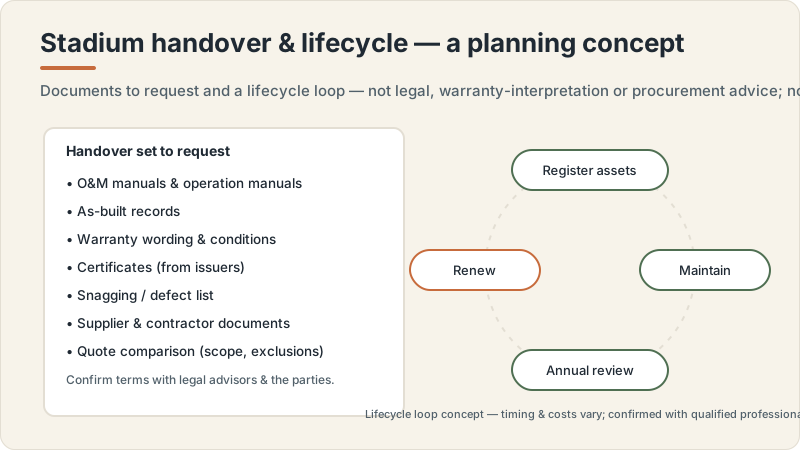
Stadium handover and lifecycle concept
Conceptual editorial diagram — not a construction drawing, specification, to-scale plan or proof of a real project. It is not engineering, structural, fire/life-safety, crowd-safety or accessibility-compliance guidance. Capacities, dimensions, standards, requirements and costs vary by facility type, audience, site, use case and governing body, and are confirmed with qualified professionals, relevant authorities and governing bodies. Build Design Hub does not design, build, inspect, certify, recommend or match anyone.
What this guide helps you prepare
This guide helps you prepare the thinking and the questions behind a stadium asset register, not the register itself as a finished technical or accounting document. It walks through the kinds of information that are commonly discussed when structuring such a register, so that when you sit down with facility managers, asset consultants, engineers, surveyors or accountants, you can describe what you want to achieve and understand the choices they present. The aim is a clearer brief and a more productive conversation, rather than a set of instructions to follow.
It also helps you separate what you can reasonably draft yourself from what genuinely needs professional input. You can gather source documents, list the asset categories your venue appears to have, and note the operational questions that matter to you. What you should not do is assume how assets must be classified, what condition or life they have, or what any of this means for tax, insurance or accounting purposes. Those are professional determinations that vary by facility, ownership model, jurisdiction and accounting approach; confirm them with qualified professionals.
- A draft brief describing what you want the register to support: maintenance planning, handover, budgeting conversations, or reporting
- A list of the source documents you already hold, such as handover packs, drawings, warranties and prior inventories
- An outline of the asset categories your venue appears to contain, framed as a starting point for professional review
- A set of open questions about ownership, responsibility and who maintains what across the facility
- Notes on which decisions you feel able to draft and which you expect to defer to qualified professionals
What to record per asset: fields and framework
When teams structure an asset register, they often discuss a consistent set of fields to capture for each asset so that records stay comparable and searchable. Commonly discussed fields include a unique identifier, a plain description, the asset category or type, its physical location within the venue, and a link back to source documents such as drawings, manuals or handover records. Other fields frequently raised include installation or acquisition context, responsible party, and any reference numbers from manufacturers or suppliers. The exact fields that suit your venue depend on how you intend to use the register and on advice from your professional team.
Beyond the identifying fields, teams often want a place to record operational and lifecycle context, such as maintenance regime, service history references, and links to any inspection or servicing arrangements. It is important to treat condition, remaining life, valuation and depreciation as professional determinations rather than fields you populate from assumption. This guide deliberately gives no figures for these. What matters at the planning stage is deciding which fields you need and why, so professionals can advise on how to populate them accurately for your facility, use case and reporting requirements.
- What unique identifier or naming convention would keep assets distinct and easy to trace back to documents?
- Which descriptive fields (type, category, location, sub-location) help people find and understand an asset?
- What links to source records (drawings, manuals, warranties, handover packs) should each entry reference?
- Which fields capture responsibility and maintenance regime, and who confirms those with the operator?
- Which fields, such as condition, life, valuation or depreciation, should be left for qualified professionals to determine?
- How will you flag assets where information is incomplete or unverified, rather than guessing?
Organising the register: hierarchy, coding and structure
An asset register becomes far more useful when it is organised into a logical structure rather than a flat list. Teams often discuss a hierarchy that moves from the whole venue down through zones, systems and individual assets, so that a spectator stand, a mechanical plant room and a pitch-side area can each contain their own assets without confusion. A consistent coding or numbering approach is frequently raised as the backbone of this structure, because it lets the same asset be found, referenced in a work order, and traced across documents. How granular the hierarchy should be is a judgement to work through with facility and asset professionals.
Structure also affects how the register connects to other systems and processes, such as maintenance planning, reporting and eventual handover. Teams often consider how categories map to responsibilities, how shared or leased assets are handled, and how the register will be kept current as things change. None of this requires you to state fixed standards or classifications as facts. The goal at the planning stage is to understand the structural choices, capture your preferences and constraints, and bring clear questions to the professionals who will help you finalise an approach suited to your facility.
- What hierarchy (venue, zone, system, component) best reflects how your facility is actually operated?
- What coding or numbering convention keeps identifiers unique, readable and stable over time?
- How should the structure handle shared, leased or third-party-owned assets within the venue?
- How granular should individual asset records be, and who advises on that level of detail?
- How will the register link to maintenance, reporting and handover processes without duplication?
- How will structure and codes be kept consistent as assets are added, moved or removed?
Planning questions before speaking with professionals
Before you engage facility managers, asset consultants, engineers, surveyors or accountants, it helps to organise your own thinking so those conversations are efficient and grounded in your real situation. Start by clarifying the purpose you want the register to serve and the audiences who will use it, because that shapes almost every later decision about fields, structure and detail. Gather the documents you already hold and note where information appears to be missing, so professionals can see your starting point rather than reconstruct it from scratch.
It also helps to be honest about the boundaries of what you can determine yourself. You can describe your venue, list apparent asset categories and record operational priorities, but you should avoid asserting conditions, values, lives or classifications. Framing these as open questions signals to professionals exactly where their expertise is needed. Remember that requirements vary by location, facility type, use case, governing body, owner, site, authority, professional team and project scope; confirm with qualified professionals rather than deciding in advance.
- What is the primary purpose of the register, and who are its intended users?
- Which source documents do we already have, and where are the obvious gaps?
- What asset categories does our venue appear to contain, as a starting point for review?
- Which operational priorities (uptime, handover, reporting) should the register support most?
- What decisions are we comfortable drafting, and which do we expect to defer entirely?
- What questions about ownership, responsibility and maintenance do we need answered first?
Questions for qualified professionals
When you meet qualified professionals, the register benefits from targeted questions that let them apply their expertise to your specific facility. Asset consultants and facility managers can advise on how to structure the hierarchy, what level of detail is appropriate, and how the register should connect to maintenance and reporting. Engineers and surveyors can help you understand how physical and systems assets are best described and recorded. Accountants and finance professionals can explain how assets are treated for reporting, valuation and depreciation purposes, none of which this guide provides.
Keep your questions framed around your context so that answers are actionable. Ask professionals to explain the choices, the trade-offs and the reasons behind their recommendations, and ask what documentation or verification they need from you. Because determinations depend on your facility, jurisdiction, ownership and reporting obligations, treat professional advice as the authority and this guide only as preparation. Confirm every classification, figure and requirement with the relevant qualified professionals, authorities and governing bodies.
- How would you recommend structuring the asset hierarchy and coding for a facility like ours?
- What fields should each asset record contain given how we intend to use the register?
- How should condition, remaining life and any valuation or depreciation be determined and by whom?
- How should shared, leased or third-party assets and their responsibilities be recorded?
- What source documentation and verification do you need from us to populate records accurately?
- How should the register be kept current, and who should own that responsibility over its life?
What this does not replace
This is an educational planning resource only. It is not a stadium construction manual and not structural, architectural, seating or stand engineering, crowd-safety, crowd-flow, evacuation, fire or life-safety, or accessibility-compliance advice, and it is not permit, zoning, inspection, certification, legal, tax, insurance or procurement advice. It does not design, build, engineer, specify, certify, inspect or approve anything, gives no capacities, dimensions, loads, revenue, ROI or costs, and offers no warranty interpretation or estimate. Requirements, standards, capacities and costs vary by location, facility type, use case, governing body, owner, site, authority, professional team and project scope, and are confirmed with qualified professionals, relevant authorities and governing bodies.
Build Design Hub does not design, build, engineer, inspect, certify, recommend, rank, verify, introduce, broker or match suppliers, contractors, consultants or professionals, and HELPERG LLC is publisher/operator only. Use this resource to prepare your own thinking and briefs, then have qualified professionals you engage directly review your project. Decisions about design, engineering, structure, crowd safety, fire and life safety, accessibility, compliance, capacity, procurement and cost must rest on those professionals, the relevant authorities and the governing bodies for your sport and location.
- Not a stadium construction manual and not structural, architectural or seating/stand engineering
- Not crowd-safety, crowd-flow, evacuation, fire/life-safety or accessibility-compliance advice
- Not permit/zoning, inspection, certification, warranty-interpretation, legal, tax, insurance or procurement advice
- Not a supplier, contractor, consultant or professional recommendation, ranking, directory or matching service
- Not an estimate and gives no capacity, dimension, revenue, ROI or cost figures — requirements and costs vary
- Qualified professional review is required before any stadium project decision
Stadium asset register preparation worksheet
- 1Write a short statement of purpose describing what you want the register to support and who will use it
- 2Gather source documents you hold: handover packs, drawings, manuals, warranties and prior inventories
- 3List the asset categories your venue appears to contain, marked as a draft for professional review
- 4Note the physical zones or areas of the venue that assets might be grouped under
- 5Draft candidate fields you think each asset record should contain, to discuss with professionals
- 6Record where information is missing, unverified or unclear, rather than filling gaps with assumptions
- 7Capture questions about who owns, operates and maintains each apparent asset category
- 8Note any shared, leased or third-party-owned assets that may need special handling
- 9List the operational priorities the register should serve, such as maintenance, handover or reporting
- 10Identify which decisions you feel able to draft and which you expect to defer to professionals
- 11Prepare questions for asset consultants, facility managers, engineers, surveyors and accountants
- 12Note that condition, life, valuation and depreciation are to be determined by qualified professionals
- 13Record which authorities, governing bodies or standards professionals say you should confirm with
- 14Keep a log of assumptions to test, so professional review can confirm or correct each one
Common mistakes to avoid
- Treating this guide as a finished register template rather than a planning framework to discuss with professionals
- Assuming asset conditions, remaining lives, valuations or depreciation instead of leaving them for qualified professionals
- Stating categories, classifications or reporting treatments as facts before professional and accounting review
- Building a flat list with no hierarchy or coding, making assets hard to find, reference or maintain
- Filling missing information with guesses rather than flagging gaps as unverified
- Ignoring shared, leased or third-party-owned assets and unclear maintenance responsibilities
- Skipping conversations with facility, engineering and finance professionals before finalising structure or fields
- Assuming requirements are the same across venues rather than confirming them for your specific facility and jurisdiction
When to involve a professional
- When you need to confirm how assets should be classified, valued, or depreciated for reporting purposes, involve qualified accountants or finance professionals
- When structuring the asset hierarchy, coding and level of detail, involve asset consultants or facility managers
- When physical or systems assets need accurate description, condition assessment or lifecycle input, involve relevant engineers or surveyors
- When the register must connect to maintenance, inspection or servicing arrangements, involve the facility operator and maintenance professionals
- When ownership, leasing or third-party responsibilities are unclear, involve appropriate legal, property or contract advisers
- When any requirement, classification or figure must be confirmed against authorities, governing bodies or standards, involve the relevant qualified professionals
Frequently asked questions
Questions readers ask about this topic
Does Build Design Hub build the register, inspect assets, or tell me what my venue must contain?
No. Build Design Hub is an educational resource and does not design, build, engineer, inspect, certify, value or classify assets, and it does not recommend, rank, verify or match suppliers, contractors or professionals. This guide provides no capacities, costs, figures or requirements. It helps you prepare questions and a brief; the determinations belong to qualified professionals you engage.
What should I record for each asset?
Teams commonly discuss identifying fields such as a unique identifier, description, category, location and links to source documents, plus operational context like responsibility and maintenance regime. This guide gives no fixed list, because the right fields depend on how you will use the register and on professional advice. Treat condition, life, valuation and depreciation as professional determinations, not fields you populate from assumption.
How detailed should the register be?
The appropriate level of detail is a judgement that depends on your facility, how it is operated and how you intend to use the register. This guide helps you frame the question rather than answer it. Discuss granularity with asset consultants and facility managers so the structure reflects your real operations without becoming impractical to maintain.
Can I use this guide to set values or useful-life figures?
No. This guide deliberately contains no valuations, depreciation, useful-life numbers, condition scores or costs, and none should be inferred from it. Those figures are professional and accounting determinations that vary by facility, jurisdiction, ownership and reporting approach. Confirm them with qualified accountants, surveyors and other relevant professionals.
Keep reading