
Who this guide is for
- Stadium and arena owners scoping a wayfinding conversation before appointing designers
- Clubs and sports organisations preparing a spectator-experience brief for their project team
- Municipalities and public-sector bodies commissioning or overseeing a venue project
- Schools, universities and community facilities planning spectator navigation at scale
- Developers and project managers coordinating wayfinding within a wider stadium programme
- Facility and operations managers preparing for handover, seasonal use and lifecycle upkeep
Planning diagram
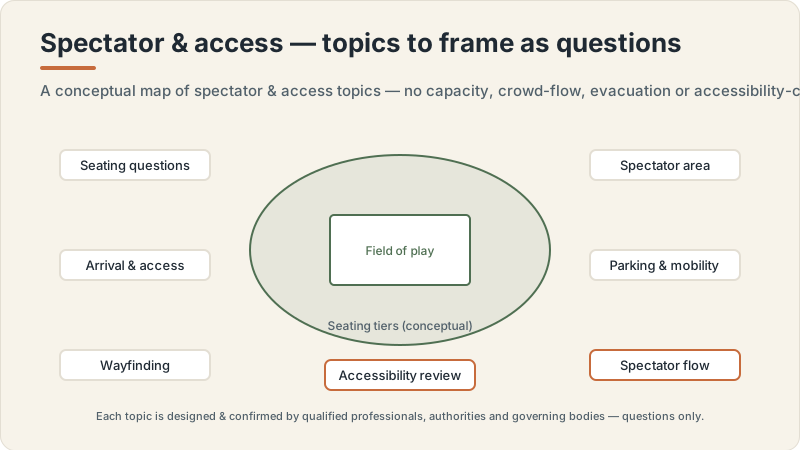
Stadium spectator and access concept
Conceptual editorial diagram — not a construction drawing, specification, to-scale plan or proof of a real project. It is not engineering, structural, fire/life-safety, crowd-safety or accessibility-compliance guidance. Capacities, dimensions, standards, requirements and costs vary by facility type, audience, site, use case and governing body, and are confirmed with qualified professionals, relevant authorities and governing bodies. Build Design Hub does not design, build, inspect, certify, recommend or match anyone.
What this guide helps you prepare
This guide helps you assemble the raw material for a productive wayfinding conversation: a description of who moves through the venue, when and why; the arrival and departure patterns you expect across different event types; and the operational realities that a designer cannot know unless you tell them. It is aimed at the stage before any layout, sign schedule or route is drawn, when the value of clear thinking is highest and the cost of changing direction is lowest. The output you are building toward is a brief and a question set, not a design.
It also helps you understand where your role stops and a qualified professional's begins. You are best placed to describe intent, constraints, stakeholders and how the venue is actually run; wayfinding designers, accessibility specialists, safety professionals and the wider team are the ones who translate that into anything buildable, safe or compliant. Keeping that boundary clear prevents you from assuming answers that only a professional review can confirm, and it keeps this guide firmly in the preparation lane rather than the design or safety lane.
- Record the different user groups who navigate the venue: spectators, hospitality guests, players, media, staff, vendors, officials and visiting supporters
- Note how arrival and departure differ between a sold-out event, a partial-capacity event and a non-event day
- List the operational facts only you know: shift patterns, seasonal use, multi-tenant sharing, other events nearby
- Capture the languages, visitor familiarity and repeat-versus-first-time mix you expect among spectators
- Separate what you can describe (intent and constraints) from what you must ask a professional to determine
- Assemble existing site information (plans, prior studies, tenancy documents) to hand to the design team rather than describing it from memory
Framing the wayfinding conversation with designers
Wayfinding at a stadium is a system, not a set of signs, and the most useful early conversations are about how that system should behave rather than what it should look like. Consider the journey in stages: how a spectator finds the venue, understands where their entrance is, moves from the concourse to their seat, locates amenities during an event, and then leaves safely and efficiently. Each stage raises different questions, and describing them in your own words gives designers a clear picture of the experience you are trying to shape without you attempting to solve it. Think in terms of decision points where a person has to choose a direction, and the moments where confusion tends to cost time or comfort.
It also helps to distinguish the layers a wayfinding strategy typically spans so you can ask about each without prescribing the answer. There is the digital and pre-arrival layer, the physical directional layer on and around the site, the concourse and vertical-circulation layer, and the operational layer of staffing, temporary measures and event-day adjustments. You do not need to decide how these interact; you need to raise them as topics and ask the professional team how they should be coordinated. Requirements and appropriate approaches vary by location, facility type, use case, governing body, owner, site, authority, professional team and project scope; confirm them with qualified professionals.
- Which spectator journey stages matter most to you, and where do you expect confusion or congestion pressure points?
- How should pre-arrival information (tickets, apps, transport, parking) connect with on-site directional cues?
- What role do concourses, vertical circulation and repeated decision points play in orientation?
- How should the wayfinding approach adapt between different event types, tenants or reduced-capacity days?
- What operational and staffing elements support the physical system on event day, and who owns them?
- Which questions in this list are yours to answer versus ones you should hand to the design and safety professionals?
Coordinating wayfinding with the wider project and operations
Wayfinding rarely lives on its own drawing; it intersects with architecture, spectator access, transport and parking planning, hospitality zoning, retail and food-service placement, safety and stewarding, branding and sponsorship, and long-term facility management. Raising these interfaces early helps you ask the right people the right questions and reduces the chance of a decision in one discipline quietly undermining orientation in another. The aim of this section is to help you map the seams, not to resolve them: you are identifying who needs to be in the room and what they each need to know.
Lifecycle and operations deserve equal attention to the initial design. A wayfinding system changes as sponsors rotate, tenants come and go, facilities are renamed, temporary event overlays are added and the venue ages. Preparing questions about updates, ownership, handover documentation and the practicalities of keeping information accurate over years is part of responsible planning. Again, none of this is a decision you make alone; it is a set of topics to confirm with your professional team, relevant authorities and governing bodies, whose requirements vary by location, facility type, use case, owner, site, authority and project scope.
- Which other disciplines (access, transport, hospitality, retail, safety, branding, FM) does wayfinding touch, and who leads each?
- How will sponsor, tenant and facility name changes be handled without eroding the system's clarity?
- What handover documentation, drawings and maintenance information do you want to specify as project deliverables?
- How are temporary event overlays, seasonal changes and multi-use configurations accounted for over time?
- Who owns wayfinding decisions after opening, and how are updates approved, funded and recorded?
- What existing brand, digital and transport-partner constraints should the design team know about from the start?
Planning questions before speaking with professionals
Before you sit down with designers, consultants or your wider project team, it pays to answer the questions that only you and your stakeholders can answer. These concern intent, priorities, constraints and how the venue is actually used, and having them written down turns a vague ambition into a brief a professional can respond to. Working through them internally also surfaces disagreements among stakeholders early, when they are cheaper to reconcile than after design has begun. Treat this as an internal alignment exercise rather than a technical one.
None of these questions ask you to determine anything technical, safe or compliant; they help you describe your situation clearly. Keep your answers as observations and objectives, and flag anything you are unsure about as a question to carry forward rather than an assumption to lock in. Where a question touches capacity, safety, accessibility, codes or standards, note it as something to confirm with qualified professionals and relevant authorities, whose requirements vary by location, facility type, use case, governing body, owner, site, authority and project scope.
- What experience do you want a first-time spectator to have from approach to seat, and what would count as failure?
- Which user groups and journeys are the highest priority, and where do their needs conflict?
- What constraints (site, existing structures, tenancy, budget envelope you are working within, brand) are fixed versus flexible?
- Which stakeholders must sign off on wayfinding decisions, and are their expectations aligned?
- What information about your operations, event mix and visitor profile do you need to gather before the first meeting?
- What questions about capacity, safety, accessibility or compliance are you explicitly deferring to qualified professionals?
Questions for qualified professionals
Once you have your internal brief, this section helps you frame what to ask the professionals you engage. Good questions invite the design, accessibility and safety specialists to explain how they would approach your situation, what information they still need, and where their responsibilities begin. Asking them to describe their process, their assumptions and their coordination with other disciplines gives you a clearer basis for comparing approaches and for understanding scope, without you needing to evaluate technical detail yourself. Record their answers so you can compare responses on a like-for-like basis.
Remember that Build Design Hub does not design, build, engineer, inspect, certify, recommend, rank, verify, introduce, broker or match any professionals, and this guide gives no capacities, dimensions, costs or requirements. Use the prompts below to structure your own conversations and quote-comparison thinking, and rely on the professionals you appoint, along with relevant authorities and governing bodies, to determine anything technical, safe or compliant. Their requirements vary by location, facility type, use case, governing body, owner, site, authority and project scope; confirm everything with them directly.
- How would you approach wayfinding for our venue, and what information do you still need from us to start?
- What assumptions are you making, and which of them depend on capacity, safety or accessibility determinations we should confirm?
- How does your scope coordinate with architecture, access, safety and facility management, and where does your responsibility end?
- How do you account for different event types, temporary overlays and long-term updates in your approach?
- What deliverables, documentation and handover materials would you provide, and how are changes handled later?
- How should we compare proposals on a consistent basis, and what should we clarify with authorities or governing bodies separately?
What this does not replace
This is an educational planning resource only. It is not a stadium construction manual and not structural, architectural, seating or stand engineering, crowd-safety, crowd-flow, evacuation, fire or life-safety, or accessibility-compliance advice, and it is not permit, zoning, inspection, certification, legal, tax, insurance or procurement advice. It does not design, build, engineer, specify, certify, inspect or approve anything, gives no capacities, dimensions, loads, revenue, ROI or costs, and offers no warranty interpretation or estimate. Requirements, standards, capacities and costs vary by location, facility type, use case, governing body, owner, site, authority, professional team and project scope, and are confirmed with qualified professionals, relevant authorities and governing bodies.
Build Design Hub does not design, build, engineer, inspect, certify, recommend, rank, verify, introduce, broker or match suppliers, contractors, consultants or professionals, and HELPERG LLC is publisher/operator only. Use this resource to prepare your own thinking and briefs, then have qualified professionals you engage directly review your project. Decisions about design, engineering, structure, crowd safety, fire and life safety, accessibility, compliance, capacity, procurement and cost must rest on those professionals, the relevant authorities and the governing bodies for your sport and location.
- Not a stadium construction manual and not structural, architectural or seating/stand engineering
- Not crowd-safety, crowd-flow, evacuation, fire/life-safety or accessibility-compliance advice
- Not permit/zoning, inspection, certification, warranty-interpretation, legal, tax, insurance or procurement advice
- Not a supplier, contractor, consultant or professional recommendation, ranking, directory or matching service
- Not an estimate and gives no capacity, dimension, revenue, ROI or cost figures — requirements and costs vary
- Qualified professional review is required before any stadium project decision
Stadium wayfinding preparation register
- 1Record every user group that navigates the venue and note their distinct journeys and priorities
- 2Document arrival and departure patterns for full-capacity, partial and non-event days as you observe them
- 3List all event types and multi-use configurations the venue hosts or plans to host
- 4Capture visitor profile assumptions: first-time versus repeat, languages, familiarity, visiting-supporter mix
- 5Gather existing site plans, prior studies, tenancy documents and brand guidelines to hand to the design team
- 6Note the operational realities (staffing, stewarding, shifts, seasonal use) only you can describe
- 7Map the disciplines wayfinding intersects and identify who leads each interface
- 8Record which constraints are fixed and which are flexible, without assuming any technical limit yourself
- 9List the stakeholders who must approve wayfinding decisions and note where expectations diverge
- 10Write down questions about capacity, safety, accessibility, codes or standards to carry to qualified professionals
- 11Prepare a consistent question set so professional responses can be compared on a like-for-like basis
- 12Note the handover documentation and maintenance information you want specified as deliverables
- 13Record how updates, name changes and temporary overlays should be owned and approved after opening
- 14Flag every item that requires confirmation from authorities, governing bodies or qualified professionals
Common mistakes to avoid
- Treating wayfinding as a late signage task rather than an early planning conversation, so key journeys are never described
- Stating capacity, dimensions, gradients or spacing as fixed facts instead of matters to confirm with qualified professionals
- Assuming requirements, codes or accessibility standards apply the same way everywhere rather than confirming them for the specific site and authority
- Designing around a single event type and overlooking partial-capacity days, multi-use configurations or temporary overlays
- Skipping stakeholder alignment, so conflicting expectations surface after design has already begun
- Ignoring lifecycle ownership, leaving no plan for sponsor changes, renaming or keeping information accurate over years
- Confusing the owner's role (describing intent and constraints) with the professional's role (determining anything technical or compliant)
- Comparing consultant proposals without a consistent question set, making scope and responsibility differences hard to see
When to involve a professional
- Involve qualified professionals as soon as any question touches capacity, spectator safety, crowd movement or evacuation
- Engage accessibility and inclusive-design specialists before assuming how requirements apply to your venue and users
- Bring in a wayfinding or experience designer once your internal brief and priorities are documented
- Consult relevant authorities and governing bodies wherever codes, standards, permits or compliance are implicated
- Involve safety, stewarding and operations professionals when wayfinding intersects with event-day movement and emergencies
- Engage your architectural and project-management team early where wayfinding coordinates with the wider build programme
Frequently asked questions
Questions readers ask about this topic
Does Build Design Hub design our stadium wayfinding, recommend suppliers or tell us our capacity and costs?
No. Build Design Hub is an educational resource only. It does not design, build, engineer, inspect, certify, recommend, rank, verify, introduce, broker or match suppliers, contractors or consultants, and it provides no capacities, dimensions, costs, requirements or code figures. This guide helps you prepare questions and a brief; a qualified professional team, along with relevant authorities and governing bodies, determines anything technical, safe or compliant.
Can this guide tell us what signage or evacuation routes our venue needs?
No. This guide stays at the planning level and deliberately avoids signage design, evacuation routing, crowd-flow modelling and any safety or code claims. Those are determined by qualified safety, accessibility and wayfinding professionals and by relevant authorities, whose requirements vary by location, facility type, use case, governing body, owner, site, authority and project scope.
When should we bring in professionals rather than continuing to plan on our own?
Use this guide to document intent, constraints, stakeholders and how the venue operates. As soon as a question touches capacity, safety, accessibility, crowd movement, codes or compliance, that is the point to involve qualified professionals and confirm with the relevant authorities. Preparing your questions first simply makes those conversations more productive.
How should we use the question sets when talking to consultants?
Ask the same core questions of each professional so you can understand their approach, assumptions, scope and coordination with other disciplines on a consistent basis. Record their answers and treat anything technical, safe or compliant as their determination to confirm, not something this guide or your own team decides.
Keep reading