
Who this guide is for
- Owners and boards planning a new stadium or a major refurbishment who want to prepare warranty questions before handover discussions
- Clubs and venue operators who will run and maintain the facility and need to understand what documentation to request
- Municipalities and public-sector project teams preparing procurement briefs and handover expectations with their advisors
- Schools, colleges and community-sport organisations scoping a stadium or large sports facility project
- Developers and project managers coordinating multiple trades who want a consistent warranty question-set and register
- Facility and estates managers who will hold, track and act on warranty documents across the asset lifecycle
Planning diagram
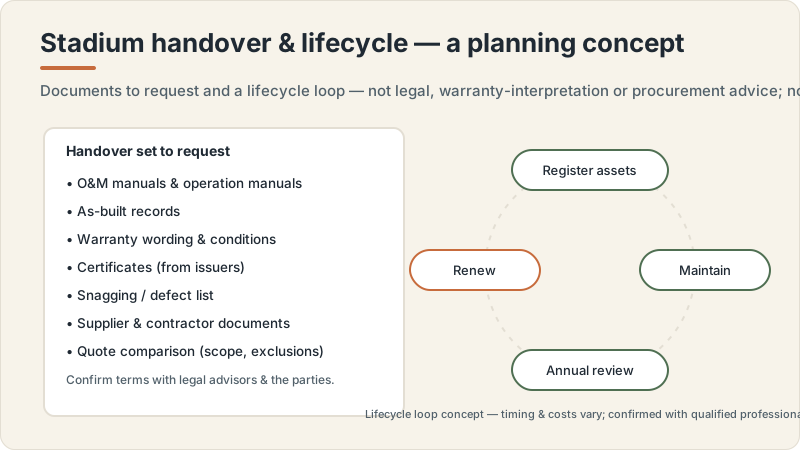
Stadium handover and lifecycle concept
Conceptual editorial diagram — not a construction drawing, specification, to-scale plan or proof of a real project. It is not engineering, structural, fire/life-safety, crowd-safety or accessibility-compliance guidance. Capacities, dimensions, standards, requirements and costs vary by facility type, audience, site, use case and governing body, and are confirmed with qualified professionals, relevant authorities and governing bodies. Build Design Hub does not design, build, inspect, certify, recommend or match anyone.
What this guide helps you prepare
This guide helps you assemble the questions and document requests you may want to have ready when warranties and guarantees come up during a stadium project. The aim is to make your conversations with qualified professionals, suppliers and contractors more structured: instead of discovering at handover that a warranty document is missing, unclear or held by the wrong party, you arrive with a prepared list of what to ask and what to request in writing. It supports the planning, scoping, procurement, handover and lifecycle stages of your project without ever telling you what a warranty covers, how long it lasts, or what it legally means.
It is deliberately not a substitute for professional judgement. Whether a particular clause applies, what a term means, and how any guarantee should be treated are questions for your qualified professional team and, where relevant, your legal, insurance and procurement advisors. This guide will not interpret documents or resolve disputes. What it can do is help you record which components typically carry separate warranties on a large sports facility, prompt you to ask who is responsible for each one, and encourage you to capture everything in writing and in one organised place so the information survives long after the project team has moved on.
- Use it to draft a list of warranty and guarantee questions to raise with your professional team early, not at handover
- Use it to identify which stadium components and works may each carry their own separate documentation
- Use it to prepare requests for documents you want provided in writing at handover
- Use it to organise a single, durable record so warranty information is not lost between phases or people
- Treat every duration, coverage and condition as something to confirm with qualified professionals, never as a fact stated here
Stadium components and works that may carry separate warranties
A stadium is not a single product; it is an assembly of many systems, materials and installed works, and each of these may be backed by its own warranty or guarantee from a different party. Playing surfaces, roofing and cladding, structural elements, seating and stand fit-out, lighting and electrical systems, drainage, mechanical and plumbing services, access and security systems, digital and audiovisual installations, and various finishes can all be sources of separate documentation. This section helps you prepare a mapping exercise: listing the components and works you expect on your project so you can ask, item by item, whether a warranty or guarantee is expected to accompany it and who would provide it.
Because responsibility can sit with a main contractor, a specialist subcontractor, an equipment supplier, a material manufacturer, or a combination, the same physical area of the stadium may involve several overlapping documents. Preparing this map does not mean you are determining coverage or duration; those remain questions for qualified professionals. It means you can ask targeted questions about each item rather than assuming a single blanket warranty exists. Note where a component involves both a product warranty from a manufacturer and a workmanship guarantee from an installer, since these are often distinct and may be honoured by different parties under different conditions that only your professional team can confirm.
- List the major systems and works on your project and ask, for each, whether a warranty or guarantee is expected to accompany it
- Ask whether a component carries both a manufacturer product warranty and a separate installer workmanship guarantee
- Ask which party would be responsible for honouring each warranty or guarantee, and who to contact
- Ask how manufacturer warranties on installed materials relate to the contractor's own works
- Note any component where responsibility appears shared or unclear, and flag it for professional clarification
- Ask whether any items are expected to have no warranty, so gaps are visible early rather than discovered later
What to request in writing and how to organise it
Getting warranty information in writing, and keeping it organised, is one of the most practical things an owner or operator can prepare for. During a project it is common for documents to be promised verbally, referenced in emails, or assumed to exist, only to prove hard to locate when they are needed years later. This section helps you prepare a list of the documents you may want to request in written form at or before handover, and a simple structure for storing them, so the burden does not fall on memory or on individuals who may have left the project. Build Design Hub does not tell you what these documents must contain; it only helps you prepare to ask for them and hold them systematically.
A durable warranty record typically benefits from consistent fields for every entry, so that anyone picking it up later can understand what they are looking at. Consider preparing a register with a row per component and columns for the responsible party, contact details, the document reference, and any conditions the supplier or contractor has told you apply. Ask your professional team how such a record should be structured for your project and who should maintain it after handover. The goal is an organised, transferable set of documents and a register that supports future maintenance and operations decisions, without this guide interpreting a single term inside them.
- Prepare a request for each warranty or guarantee to be provided in writing, with document references, before or at handover
- Ask who will hold the master set of warranty documents after the project team disbands
- Prepare a register with consistent fields: component, responsible party, contact, document reference, conditions to confirm
- Ask whether any registration, activation or notification steps are said to apply, and record them without interpreting them
- Ask how the warranty document set should be handed over and to whom, in a transferable format
- Note where documents are promised but not yet received, so outstanding items stay visible
Planning questions before speaking with professionals
Before you sit down with your qualified professional team, it helps to organise your own thinking so the conversation is efficient and complete. This means gathering what you already know about the project, being honest about what you do not yet understand, and listing the warranty and guarantee topics you want covered. Preparing these questions in advance does not require any technical knowledge of warranty law or terms; it simply helps you avoid leaving the meeting with unanswered questions or an incomplete document set. The questions below are prompts to shape your own briefing notes, not statements about what any warranty involves.
It also helps to think ahead about the whole lifecycle of the facility, not just the moment of handover. Warranties often interact with how a venue is operated and maintained, and with who is responsible when something needs attention later. Preparing questions about record-keeping, responsibility transfer and future operations lets you raise these with professionals while the project is fresh, rather than after teams have dispersed. Keep every prompt framed as a question to confirm, because coverage, duration, conditions and obligations vary by project and must be verified with qualified professionals.
- What components and works on my project are likely to carry warranties or guarantees, and who should I ask about each?
- What documents should I be prepared to request in writing, and by when in the project?
- Who will hold and maintain the warranty record after handover, and how should it be structured?
- What questions should I raise about the relationship between product warranties and workmanship guarantees?
- What lifecycle and operations topics might affect warranties, so I can ask about them now rather than later?
- What do I not yet understand well enough to discuss, and which professional should I ask about it?
Questions for qualified professionals
The following prompts are intended to help you build an agenda for discussions with qualified professionals such as your project team, contract advisors, and legal, insurance or procurement specialists as appropriate. Build Design Hub does not interpret warranty terms, confirm coverage, or advise on obligations; these are questions for you to put to the right professionals, who can respond in the context of your specific project, location and documents. Bring your component map, your draft register and your list of outstanding items so the professionals can work from concrete material rather than generalities.
Use these questions to clarify responsibility, documentation, conditions and process, and to confirm who owns which decisions after handover. Because requirements and terms vary by location, facility type, use case, governing body, owner, site, authority, professional team and project scope, treat the answers as project-specific guidance from your advisors rather than anything this guide has stated. If a professional's answer raises new questions, add them to your register and follow up rather than assuming.
- Which warranties and guarantees do you expect on this project, and which party is responsible for each?
- How should the warranty documents be structured, transferred and stored so they remain usable long after handover?
- What conditions or obligations should I be aware of, and who can interpret the terms of each document?
- How do warranties interact with the way this facility will be operated and maintained over its lifecycle?
- Which questions here fall to legal, insurance or procurement advisors rather than the design or construction team?
- What should I do if a promised warranty document is missing, unclear, or held by a party I cannot reach?
What this does not replace
This is an educational planning resource only. It is not a stadium construction manual and not structural, architectural, seating or stand engineering, crowd-safety, crowd-flow, evacuation, fire or life-safety, or accessibility-compliance advice, and it is not permit, zoning, inspection, certification, legal, tax, insurance or procurement advice. It does not design, build, engineer, specify, certify, inspect or approve anything, gives no capacities, dimensions, loads, revenue, ROI or costs, and offers no warranty interpretation or estimate. Requirements, standards, capacities and costs vary by location, facility type, use case, governing body, owner, site, authority, professional team and project scope, and are confirmed with qualified professionals, relevant authorities and governing bodies.
Build Design Hub does not design, build, engineer, inspect, certify, recommend, rank, verify, introduce, broker or match suppliers, contractors, consultants or professionals, and HELPERG LLC is publisher/operator only. Use this resource to prepare your own thinking and briefs, then have qualified professionals you engage directly review your project. Decisions about design, engineering, structure, crowd safety, fire and life safety, accessibility, compliance, capacity, procurement and cost must rest on those professionals, the relevant authorities and the governing bodies for your sport and location.
- Not a stadium construction manual and not structural, architectural or seating/stand engineering
- Not crowd-safety, crowd-flow, evacuation, fire/life-safety or accessibility-compliance advice
- Not permit/zoning, inspection, certification, warranty-interpretation, legal, tax, insurance or procurement advice
- Not a supplier, contractor, consultant or professional recommendation, ranking, directory or matching service
- Not an estimate and gives no capacity, dimension, revenue, ROI or cost figures — requirements and costs vary
- Qualified professional review is required before any stadium project decision
Stadium warranty preparation register and question worksheet
- 1Record every major stadium component and work item you expect on the project, one row per item
- 2For each item, note whether a warranty or guarantee is expected and who would provide it (to confirm with professionals)
- 3Record the responsible party and current contact details for each expected warranty or guarantee
- 4Note where an item may involve both a manufacturer product warranty and a separate installer workmanship guarantee
- 5List the documents you intend to request in writing, and the point in the project by which you want them
- 6Prepare a column for any conditions, registration or notification steps a supplier or contractor mentions, without interpreting them
- 7Record which documents have been received, which are promised, and which are still outstanding
- 8Note who will hold the master warranty document set after the project team disbands
- 9Capture how the warranty record should be structured and handed over in a transferable format
- 10List your open questions for qualified professionals, grouped by who should answer them
- 11Record lifecycle and operations topics that may interact with warranties, for discussion while the project is fresh
- 12Note any component you expect to have no warranty, so gaps are visible rather than assumed away
- 13Keep a log of professional advice received, with dates and the adviser, so answers are traceable
- 14Flag every duration, coverage or condition as to be confirmed with qualified professionals, never recorded as a fact
Common mistakes to avoid
- Assuming a single blanket warranty covers the whole stadium, rather than mapping the many separate documents that different parties may provide
- Treating warranty durations, coverage or exclusions as fixed facts instead of items to confirm with qualified professionals
- Relying on verbal or emailed assurances and never requesting the documents in writing before handover
- Leaving no clearly named holder for the warranty record, so documents scatter or disappear once the project team moves on
- Confusing a manufacturer product warranty with an installer workmanship guarantee, and assuming one party will honour both
- Trying to interpret warranty terms yourself instead of putting interpretation questions to appropriate legal, insurance or procurement professionals
- Skipping professional review of the warranty question-set and document requests before finalising the project brief
- Discovering missing or unclear documents years later because no register tracked outstanding items during the project
When to involve a professional
- When you need any warranty term, condition or exclusion explained or interpreted, which is a question for legal or contract professionals, not this guide
- When responsibility for a component appears shared or unclear between contractor, subcontractor, supplier and manufacturer
- Before finalising a project brief or procurement documents that reference warranties, guarantees or defects arrangements
- When preparing for handover and confirming which documents must be provided and to whom
- When a promised warranty document is missing, unclear, or held by a party you cannot reach
- When warranty questions intersect with insurance, tax, procurement, or code and certification matters that require specialist advisors
Frequently asked questions
Questions readers ask about this topic
Does Build Design Hub design, build, inspect or certify stadiums, or tell me what my warranties cover?
No. Build Design Hub is an educational publisher operated by HELPERG LLC. It does not design, build, engineer, inspect, certify, recommend, rank, verify, introduce, broker or match suppliers, contractors, consultants or professionals, and it does not provide capacities, costs, durations or requirements. It also does not interpret warranty terms or tell you what any document covers. This guide only helps you prepare questions and organise documents to discuss with qualified professionals.
Can this guide tell me how long a stadium warranty should last or what it must include?
No. Warranty durations, coverage, conditions and exclusions vary by location, facility type, use case, governing body, owner, site, authority, professional team and project scope. This guide never states them as facts. It helps you prepare the questions to ask so your qualified professionals and, where relevant, legal, insurance and procurement advisors can answer in the context of your specific project and documents.
What should I do before speaking with professionals about warranties?
Gather what you know about the project, list the components and works you expect, and draft a register with the questions and document requests you want to cover. Bring this preparation to the meeting so the discussion is efficient. The guide's planning-questions and register sections are designed to help you build exactly this kind of briefing without any technical or legal knowledge.
Who should hold the warranty documents after the project is finished?
That is a question to settle with your project team and confirm in writing, since it depends on how your facility will be owned and operated. This guide encourages you to ask early who will hold the master set, how it should be structured, and how it will be transferred, so the documents remain usable long after the project team has moved on. It does not decide this for you.
Keep reading