
Who this guide is for
- Prospective court owners preparing to talk to lighting installation contractors for the first time
- Operators planning a new court or an upgrade who want a structured question set before comparing options
- Anyone coordinating multiple trades who needs to understand where lighting work meets other scopes
- Readers who want to capture references and credentials as questions to ask, not claims to accept
- Owners assembling a research file before engaging qualified electrical and lighting professionals
- Facility planners separating their own preparation from decisions that need professional sign-off
Planning diagram
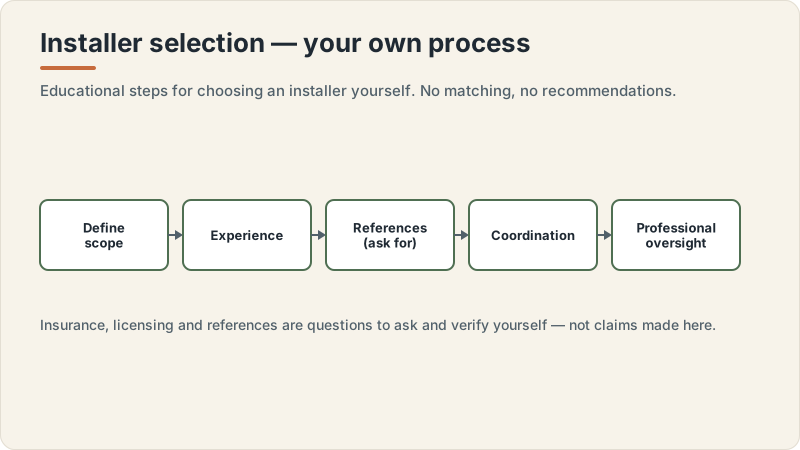
Installer selection process concept
Conceptual editorial diagram — not a construction drawing, specification or to-scale plan. Official court dimensions, standards, drainage, structure and lighting requirements vary by sport, site and location and are confirmed with the relevant federation, supplier and qualified professionals.
What this research helps you prepare
This page helps you build your own list of questions and a comparison structure for conversations with lighting installation contractors. The aim is preparation: knowing what to ask, what to write down, and where a qualified professional needs to be involved, before any commitment is made.
Lighting work on a sports court usually touches several other parts of the project, so clarity about scope and coordination matters early. Preparing your questions in advance lets you record each contractor's answers consistently and compare them yourself, rather than relying on impressions from separate conversations.
Nothing here verifies, ranks or recommends a contractor, and nothing here is an electrical, engineering or design instruction. It is a worksheet to help you have informed discussions and to decide which questions you still need a qualified professional to confirm.
- A consistent question set to use across every contractor conversation
- A place to record answers about scope, coordination and credentials in your own words
- Clarity on which questions you should route to a qualified electrical or lighting professional
- An organised research file you can review before engaging anyone
Scope clarity and site-specific review
Lighting scope can be defined very differently from one conversation to the next, so it helps to ask each contractor to describe in their own words exactly what they would and would not cover. Ask whether they are quoting for installation only, whether any design or specification work is included, and what they assume is already in place at the site.
Because every site is different, ask how they would review your specific location before confirming anything, and what site information they would need from you. Treat any figure for cost, timeline or capability as something that varies and must be confirmed in writing for your project rather than taken as a general rule.
Where a question touches the lighting design itself, the electrical supply, structural fixings or how light reaches the playing area, note it as something a qualified professional should confirm. Your job here is to capture the boundaries clearly, not to resolve technical questions yourself.
- What is included in the installation scope and what is explicitly excluded
- What they assume already exists on site before they begin
- How they would carry out a site-specific review and what information they need from you
- Which parts of the work involve design or specification versus installation
- Where they expect a qualified professional to confirm details
Experience, coordination and handoff documentation
Rather than asking for a self-description of being the best or most trusted, ask experience questions you can record neutrally: what comparable work the contractor has done, how they typically organise a job of this kind, and how they handle situations where their work depends on another trade finishing first.
Coordination is a common source of risk on court projects because lighting often interfaces with the base, the surface, fencing or enclosures and the electrical supply. Ask how they coordinate with other contractors, who is responsible at each interface, and what happens if a sequencing issue arises. Capture these answers so you can compare how clearly each contractor explains the handoffs.
Ask what documentation you would receive at handover, such as records of what was installed and any information a qualified professional would need for inspection, testing or sign-off. Note that what is required varies by location, and the relevant authority and qualified professionals should confirm what documentation your project needs.
- Examples of comparable work and how they organise a job like yours
- How they coordinate with other trades and where each interface responsibility sits
- What happens if another trade's work is delayed or incomplete
- What handover documentation they provide and in what form
- Which records a qualified professional may need for inspection or testing
What to ask before comparing options
Before you line contractors up side by side, make sure you are comparing the same thing. Differences in what each one assumes is included, what the site already provides, or how coordination is handled can make two conversations look similar when they are not. Ask each contractor the same core questions and record the answers in the same structure.
References are something to ask for, not something to invent or assume. You can ask whether a contractor can provide references and how they would do so, and then follow your own process to consider them, but this page does not supply, verify or vouch for any reference, contractor or past project.
Insurance and licensing are also best treated as questions to ask rather than claims to accept at face value. Ask what cover and credentials a contractor holds and how that can be confirmed through the proper channels, and note that what is required varies by location and should be checked with the relevant authority and qualified professionals.
- Are all contractors answering the same scope and assumption questions
- How does each one describe coordination and interface responsibility
- Can they provide references, and through what process (you assess them yourself)
- What insurance and licensing do they hold, and how can it be confirmed
- Which open questions still need a qualified professional to settle
Questions for qualified professionals
Some questions are better directed to a qualified electrical, lighting or engineering professional than to a contractor you are comparing. These are the points where independent review protects your project, because they involve design, safety, compliance or technical confirmation rather than scope and logistics.
Prepare these questions separately so you can raise them with the right professional at the right time. Asking them does not turn this page into engineering or electrical advice; it simply helps you recognise which decisions need professional confirmation for your specific site and which official requirements you must verify with the relevant authority or federation.
- Whether the proposed lighting approach suits your specific site and intended use
- What the electrical supply, fixings and structural considerations require for your project
- Which official requirements, standards or permissions apply in your location
- What inspection, testing or sign-off your project needs and who must perform it
- Which parts of any contractor proposal should be independently reviewed before you commit
What this does not replace
This is an educational project-preparation resource only. It is not a supplier or contractor recommendation, not contractor matching, and not an estimate. It does not provide procurement, legal, tax or customs advice, and it does not provide engineering, design, electrical, construction or inspection advice.
Build Design Hub does not recommend, rank, verify, endorse or introduce suppliers or contractors, and naming or vouching for any specific company is outside what this page does. HELPERG LLC is the publisher and operator only.
Requirements vary by location and project, and costs vary by site, scope, supplier, access, drainage, lighting design, surface, shipping, local conditions and professional requirements. Confirm official requirements with the relevant authorities, federations, suppliers and qualified professionals, and consult qualified professionals before making any project, legal, tax, customs, engineering, construction or procurement decisions.
Lighting contractor question worksheet
- 1Write down exactly what each contractor says is included and excluded in their scope
- 2Record what each one assumes is already in place at your site
- 3Note how each contractor would carry out a site-specific review
- 4Capture how they coordinate with other trades and where each interface responsibility sits
- 5List what happens, in their words, if another trade's work is delayed
- 6Record what handover documentation they would provide
- 7Ask whether they can provide references and note the process (you assess them yourself)
- 8Ask what insurance and licensing they hold and how it can be confirmed through proper channels
- 9Mark every answer about cost, time or capability as something to confirm in writing
- 10Flag each question that needs a qualified electrical or lighting professional to settle
- 11Keep all answers in the same structure so you can compare consistently
- 12Note which official requirements you still need to verify with the relevant authority
Common mistakes to avoid
- Comparing contractors whose scopes assume different starting conditions, so the comparison is not like-for-like
- Treating self-descriptions such as best or trusted as evidence rather than asking specific, recordable questions
- Assuming references or credentials are valid without asking how they can be confirmed through proper channels
- Overlooking coordination and interface responsibilities where lighting work meets other trades
- Accepting a figure for cost or timeline as fixed instead of confirming it in writing for your project
- Skipping a site-specific review and relying on general assumptions about the location
- Leaving technical or design questions with a contractor instead of routing them to a qualified professional
- Failing to clarify what handover documentation you will receive for later inspection or sign-off
When to involve a professional
- Involve a qualified electrical or lighting professional to confirm whether a proposed approach suits your specific site and intended use
- Ask an engineering or electrical professional about supply, fixings and structural considerations rather than resolving them yourself
- Have a qualified professional identify which official requirements, standards and permissions apply in your location
- Use a professional to confirm what inspection, testing or sign-off your project needs and who must carry it out
- Seek independent professional review of any contractor proposal before you make a commitment
- Engage qualified professionals before making project, legal, tax, customs, engineering, construction or procurement decisions
Frequently asked questions
Questions readers ask about this topic
Does this page recommend a lighting contractor for my court?
No. This is an educational preparation resource that helps you build your own questions. Build Design Hub does not recommend, rank, verify or introduce any contractor, and HELPERG LLC is publisher and operator only.
How should I handle references and credentials?
Treat them as questions to ask, not claims to accept. You can ask whether a contractor provides references and what insurance and licensing they hold, then confirm through proper channels yourself. This page does not supply or vouch for any reference.
Can you tell me what lighting work should cost or how long it takes?
No. Costs and timelines vary by site, scope, supplier, access, lighting design, local conditions and professional requirements. Treat any figure as something to confirm in writing directly with contractors and qualified professionals.
Will this tell me what the technical or electrical requirements are?
No. Requirements vary by location and project and are not stated here as fact. Direct technical, electrical and compliance questions to qualified professionals and the relevant authority for your site, and confirm before deciding anything.
Is this contractor matching or a directory?
No. It is a research worksheet you fill in yourself. It does not match, broker, rank or list contractors, and it is not a substitute for qualified professional review of your project.
Keep reading