
Who this guide is for
- Owners and developers scoping a new or converted indoor sports facility who need to understand which professionals to involve
- Sports clubs and community organisations preparing to discuss an indoor hall, gym or court project with advisors
- Schools and education bodies planning an indoor sports hall or multi-purpose space and mapping the roles involved
- Municipalities and public-sector teams preparing project briefs and stakeholder discussions for indoor facilities
- Facility managers and operations leads preparing handover, lifecycle and operational questions for a project team
- Project coordinators and internal steering groups assembling the questions to bring to qualified professionals
Planning diagram
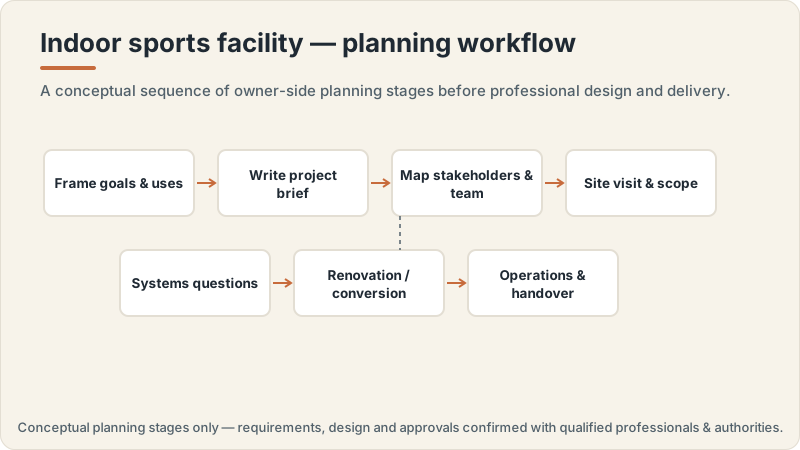
Indoor sports facility planning workflow concept
Conceptual editorial diagram — not a construction drawing, specification, to-scale plan or proof of a real project. It is not engineering, structural, fire/life-safety, crowd-safety or accessibility-compliance guidance. Capacities, dimensions, standards, requirements and costs vary by facility type, audience, site, use case and governing body, and are confirmed with qualified professionals, relevant authorities and governing bodies. Build Design Hub does not design, build, inspect, certify, recommend or match anyone.
What this guide helps you prepare
This guide helps you prepare the people side of an indoor sports facility project: understanding the professional roles a project may involve, how those roles relate to one another, and how to plan the conversations that engage them. It is organised around preparation - drafting a project brief, clarifying your goals and constraints, mapping stakeholders, and structuring the questions you bring to qualified professionals. It does not tell you how to design or build anything, and it does not size, specify or approve any part of a facility.
The aim is to help you arrive at professional conversations already able to describe what you are trying to achieve, who your facility is for, what activities it may host, and what uncertainties you carry. Requirements for an indoor sports facility vary by location, facility type, use case, governing body, owner, site, authority, professional team and project scope, and they must be confirmed with qualified professionals and relevant authorities. This guide keeps every technical question framed as something to confirm, never as a stated fact.
- Record your project goals in plain language: intended activities, users and how the space might be shared
- List the stakeholders who should be consulted, including operators, users, governing or oversight bodies and neighbours
- Note the open questions and assumptions you want qualified professionals to test rather than confirm yourself
- Gather any existing documents - site information, briefs, prior studies, drawings - that a professional team may ask to see
- Draft a short brief describing scope, constraints and what a successful outcome would look like for your organisation
- Identify decisions that belong to qualified professionals rather than to the owner, and mark them as questions to raise
Mapping the professional roles an indoor sports facility may involve
Indoor sports facilities often bring together a range of professional disciplines, and the exact mix depends on your project. An architect or lead designer commonly coordinates the overall concept and how spaces relate. Structural engineers consider the building's frame and how it carries loads, while mechanical, electrical and plumbing (MEP) engineers consider systems such as ventilation, power and water. Specialists may be involved for areas such as acoustics, lighting, accessibility and fire and life safety, and advisors may support planning, cost, operations or governing-body liaison. This guide names these roles so you can recognise them; it does not decide which your project needs or design their scope.
Because indoor sports halls combine large clear spans, active use, changing and support rooms and varied activities, several disciplines usually interact rather than working in isolation. A decision in one area can raise questions in another, which is why coordination between disciplines is itself something to discuss early. Which roles apply, and how they are engaged, varies by location, facility type, use case, governing body, owner, site, authority, professional team and project scope; confirm the appropriate team with qualified professionals. Nothing here should be read as a statement that a particular role, sequence or arrangement is required.
- Ask which disciplines a professional considers relevant to your specific facility type and intended activities
- Note the distinction between a lead designer or architect and the specialist and engineering roles they may coordinate
- Consider where acoustic, lighting, accessibility and fire or life-safety input may be discussed, and treat each as a professional's domain
- Identify where governing-body or authority liaison may sit within the team, and ask who typically leads it
- Record which decisions your organisation makes and which belong to qualified professionals
- Ask how the disciplines coordinate with one another and where their considerations overlap on your project
Planning how and when to engage each role
Beyond knowing which roles exist, it helps to plan how and when you might engage them and what you would ask each one to clarify. Engagement is a sequence of conversations: an initial discussion to explore scope and feasibility, then more detailed input as the picture develops. This guide helps you prepare those conversations - the brief you bring, the questions you ask, and the documentation you request - without prescribing a project method, a phase order or a contract structure, all of which are matters for qualified professionals and your own advisors.
When planning engagement, it is useful to separate what you can describe (your goals, users, constraints and open questions) from what a professional must assess (feasibility, systems, compliance considerations and technical detail). For building-systems areas such as ventilation, lighting, acoustics, temperature, accessibility and safety, keep your preparation at the level of what to ask the relevant professional and what documentation to request. Do not attempt to set thresholds, sizes, targets or specifications yourself; those depend on many project-specific factors and must be confirmed with qualified professionals, relevant authorities and governing bodies.
- Prepare an early-conversation brief that describes goals and constraints without proposing technical solutions
- For each role, note what you want to understand and what documentation or written output you would request
- Ask each professional how their work connects to the others and where hand-offs or coordination points occur
- Keep systems questions at the 'what should we ask and confirm' level rather than specifying values or products
- Record which authorities, governing bodies or oversight groups a professional says should be consulted, and when
- Plan how you will capture, compare and follow up on the answers and documents you receive
Planning questions before speaking with professionals
Before you approach qualified professionals, it is worth organising what you already know and what you do not. Clear internal answers about who the facility is for, what activities it may host, how it might be shared and what constraints you carry will make professional conversations more productive. These are preparation questions for your own team - they help you describe the project, not decide its technical shape. Anything touching requirements, capacities, systems or compliance stays an open question to raise with professionals and authorities.
Working through these questions internally also surfaces the assumptions you may be carrying, such as an idea about size, use intensity or a system, that a professional should test rather than inherit. Naming those assumptions and marking them as unconfirmed is one of the most useful things you can do before engagement. Requirements vary by location, facility type, use case, governing body, owner, site, authority, professional team and project scope; treat every such point as something to confirm with qualified professionals.
- Who is the facility for, and what activities or sports might it need to accommodate now and later?
- How might the space be shared between users or uses, and who are the stakeholders to consult?
- What site, building or operational constraints do we already know about, and what is still unknown?
- What assumptions are we carrying about size, use, systems or timing that a professional should test?
- Which authorities, governing bodies or oversight groups might need to be involved, according to professionals?
- What documents, briefs or prior studies do we have, and what gaps might a professional ask us to fill?
Questions for qualified professionals
Once you engage qualified professionals, your prepared questions help you understand their view of scope, coordination and the considerations specific to your facility. The questions below are framed to draw out professional judgement and documentation rather than to extract a number you might treat as fixed. They deliberately avoid asking this guide or any single source to confirm requirements, because requirements depend on location, facility type, use case, governing body, owner, site, authority, professional team and project scope, and must be confirmed with the professionals and authorities responsible.
For any building-systems topic - ventilation, lighting, acoustics, temperature, accessibility or safety - keep your questions focused on what the relevant professional considers, what standards or authorities they refer to, and what written documentation they will provide. Ask how their conclusions were reached and what they depend on, rather than asking for a threshold you could apply yourself. This keeps decisions with the qualified professionals who are responsible for them and gives you documentation you can carry through later project stages.
- Which disciplines and specialists do you consider necessary for a facility of this type and use, and why?
- How do the roles on this project coordinate, and where are the key hand-off or overlap points?
- For each building-systems area, what should we ask, what do you assess, and what documentation will you provide?
- Which authorities, codes or governing bodies apply here, and how will compliance be confirmed and evidenced?
- What are the main uncertainties or risks at this stage, and what would reduce them before decisions are made?
- What documentation should we request and retain for operations, handover and lifecycle planning later?
What this does not replace
This is an educational planning resource only. It is not an indoor sports facility construction manual and not structural or architectural design, HVAC/ventilation, lighting or acoustic engineering, fire or life-safety, or accessibility-compliance advice, and it is not permit, zoning, inspection, certification, legal, tax, insurance or procurement advice. It does not design, build, engineer, specify, size, certify, inspect or approve anything, gives no capacities, dimensions, clearances, lux, air-change rates, acoustic or temperature thresholds, revenue, ROI or costs, and offers no warranty interpretation or estimate. Requirements, standards, capacities and costs vary by location, facility type, use case, governing body, owner, site, authority, professional team and project scope, and are confirmed with qualified professionals, relevant authorities and governing bodies.
Build Design Hub does not design, build, engineer, inspect, certify, recommend, rank, verify, introduce, broker or match suppliers, contractors, consultants or professionals, and HELPERG LLC is publisher/operator only. Use this resource to prepare your own thinking and briefs, then have the qualified professionals you engage directly — architects, structural and building-services engineers, lighting, acoustic, accessibility and fire/life-safety specialists, and legal or procurement advisors where appropriate — review your project. Decisions about design, engineering, systems, safety, accessibility, compliance, capacity, procurement and cost must rest on those professionals, the relevant authorities and the governing bodies for your sport and location.
- Not an indoor sports facility construction manual and not structural or architectural design
- Not HVAC/ventilation, lighting or acoustic engineering, fire/life-safety or accessibility-compliance advice
- Not permit/zoning, inspection, certification, warranty-interpretation, legal, tax, insurance or procurement advice
- Not a supplier, contractor, consultant or professional recommendation, ranking, directory or matching service
- Not an estimate and gives no capacity, dimension, system-performance, revenue, ROI or cost figures — requirements and costs vary
- Qualified professional review is required before any indoor sports facility project decision
Indoor sports facility project-team preparation worksheet
- 1Record the facility type and the activities or sports it may need to accommodate, noting these are subject to professional review
- 2Write a short plain-language project brief describing goals, users and what a successful outcome looks like
- 3List all stakeholders to consult, including operators, users, governing bodies, authorities and neighbours
- 4Gather existing documents - site information, prior briefs, studies and drawings - that professionals may request
- 5Map the professional roles your project may involve (architect, structural, MEP, and relevant specialists and advisors)
- 6For each role, note what you want to understand and what written documentation you would request
- 7List the assumptions you are carrying (size, use, systems, timing) and mark each as unconfirmed pending professional input
- 8Separate decisions that belong to your organisation from those that belong to qualified professionals
- 9Record the building-systems topics (ventilation, lighting, acoustics, temperature, accessibility, safety) as questions to ask, not values to set
- 10Note which authorities and governing bodies professionals say should be consulted, and at what stage
- 11Draft the coordination questions about how disciplines connect and where hand-offs occur
- 12Prepare a method to capture, compare and follow up on professional answers and documents
- 13List the documentation you will want for operations, handover and lifecycle planning
- 14Record open risks and uncertainties you want professionals to help reduce before decisions are made
Common mistakes to avoid
- Stating a dimension, capacity, clearance or system value as fixed instead of treating it as something professionals confirm
- Assuming requirements, codes or governing-body rules apply a certain way without confirming with qualified professionals and authorities
- Treating a systems decision (ventilation, lighting, acoustics, temperature, accessibility, fire and life safety) as the owner's choice rather than a professional's domain
- Engaging a single professional and assuming that role covers disciplines that may actually need separate specialists
- Carrying assumptions about size, use intensity or timing into professional conversations without flagging them as unconfirmed
- Skipping professional review of feasibility or compliance considerations because the project 'looks simple'
- Overlooking coordination between disciplines and expecting each professional to work in isolation
- Failing to request and retain written documentation needed for later operations, handover and lifecycle planning
When to involve a professional
- Before confirming any technical requirement, capacity, dimension, clearance or system value, involve the relevant qualified professional
- When questions touch codes, permits, zoning, governing-body rules or compliance, involve professionals and the relevant authorities
- For any building-systems area - ventilation, lighting, acoustics, temperature, accessibility, fire and life safety - involve the appropriate specialist
- When you are unsure which disciplines your project needs or how they should coordinate, seek professional guidance early
- Before decisions with structural, safety or accessibility implications are made, involve a qualified professional to assess them
- When preparing for inspection, certification, handover or lifecycle documentation, involve the professionals responsible for that work
Frequently asked questions
Questions readers ask about this topic
Does Build Design Hub design, build, engineer, inspect or certify indoor sports facilities, or match me with firms?
No. Build Design Hub is an educational resource. It does not design, build, engineer, inspect, certify or approve facilities; it does not design HVAC, ventilation, lighting or acoustic systems; and it does not recommend, rank, verify, introduce, broker or match suppliers, contractors, consultants or professionals. This guide gives no capacities, dimensions, clearances, costs or requirements. It helps you prepare questions and briefs to discuss with qualified professionals you engage independently.
Can this guide tell me what size, capacity or systems my sports hall needs?
No. Requirements such as size, capacity, clearances, ventilation, lighting, acoustics, temperature and accessibility vary by location, facility type, use case, governing body, owner, site, authority, professional team and project scope. This guide deliberately states none of them as fact. It helps you frame those points as questions to confirm with qualified professionals and relevant authorities, and it explains what documentation you might request from them.
How do I know which professional roles my project actually needs?
That is a judgement for qualified professionals based on your specific project. This guide helps you recognise the roles a project may involve - architect or lead designer, structural and MEP engineers, and specialists such as acoustic, lighting, accessibility and fire and life safety - so you can ask an appropriate professional which apply to your facility and how they should coordinate. It does not decide the team for you.
What should I prepare before speaking with professionals?
A clear plain-language brief describing your goals, users and intended activities; a stakeholder list; any existing documents; the assumptions you are carrying marked as unconfirmed; and organised questions for each role. The preparation worksheet in this guide can help. The aim is to arrive able to describe your project and your open questions, so professional conversations start from shared understanding.
Keep reading