
Who this guide is for
- Sports clubs and community organisations preparing to commission or refurbish a hall they will share across several activities
- School, college and academy leaders scoping an indoor sports hall for curriculum, extracurricular and community use
- Municipal and local-authority teams planning a public multi-use facility with competing bookings and stakeholders
- Developers and project sponsors assembling an early brief before appointing designers or consultants
- Facility managers and operators who must live with changeover, scheduling and maintenance realities after handover
- Project managers and steering groups coordinating stakeholder input into a single, coherent brief
Planning diagram
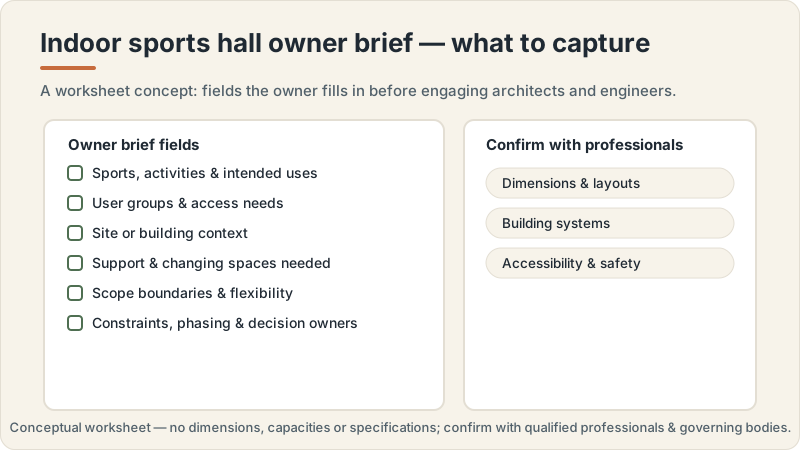
Indoor sports hall owner brief worksheet concept
Conceptual editorial diagram — not a construction drawing, specification, to-scale plan or proof of a real project. It is not engineering, structural, fire/life-safety, crowd-safety or accessibility-compliance guidance. Capacities, dimensions, standards, requirements and costs vary by facility type, audience, site, use case and governing body, and are confirmed with qualified professionals, relevant authorities and governing bodies. Build Design Hub does not design, build, inspect, certify, recommend or match anyone.
What this guide helps you prepare
This guide helps you build the raw material of a project brief for a multi-purpose sports hall: a clear statement of who the hall is for, what activities it must accommodate, how those activities compete for the same space, and which questions you need qualified professionals to answer. It helps you separate what is genuinely an owner decision — priorities, intended uses, operating model, budget appetite in principle — from what must be determined by architects, engineers, governing bodies and relevant authorities. That separation is the single most valuable thing an early brief can achieve, because it prevents the project team from assuming the owner has already settled matters that actually require professional judgement.
It also helps you document uncertainty rather than paper over it. A strong brief openly lists the activities you hope to host, the ones you are unsure about, and the trade-offs you have not yet resolved, so professionals can advise on feasibility instead of discovering hidden expectations late. Nothing here is a construction, design, or compliance instruction: no dimensions, capacities, system specifications, or code requirements are stated as facts. Where this guide touches lighting, ventilation, acoustics, temperature, accessibility or safety, it stays strictly at the level of what to ask the relevant professional and what documentation to request.
- Record the full list of intended, possible and explicitly excluded activities for the hall
- Capture stakeholder priorities and where they conflict, without resolving them prematurely
- Distinguish owner decisions from matters that require professional or governing-body input
- Note every technical or regulatory assumption as an open question, not a settled fact
- Assemble background documents professionals will likely request about the site and its use
- Frame budget, programme and phasing as intentions to test, not fixed commitments
Framing competing use needs in a shared hall
The heart of a multi-purpose brief is naming the competing demands before designers see them. Court sports, structured training, school PE, informal community sessions, fitness classes and occasional events each imply different expectations for the floor, the surrounding zones, the support rooms and the way the space is scheduled — and those expectations frequently pull against one another. Rather than trying to satisfy every use equally, a useful brief ranks activities by importance to the owner, distinguishes primary from occasional uses, and states which activities the hall must accommodate versus which would simply be nice to have. This gives professionals a hierarchy to design around instead of an impossible mandate to be perfect for everything.
When you frame these needs, resist the urge to translate them into technical targets yourself. It is not the owner's role to decide floor markings, surface performance, line-of-sight, or how any activity's governing-body expectations should be met; those are questions for qualified professionals and the relevant governing bodies, and requirements vary by location, facility type, use case, governing body, owner, site, authority, professional team and project scope. Your job in the brief is to describe the use clearly — who plays, how often, at what level, for whom — and to flag where two uses seem hard to reconcile, so the design team can advise on where compromise, zoning, or scheduling may be needed and where it may not.
- List each intended activity and note whether it is a primary, secondary or occasional use
- For each activity, describe the users, frequency, and level of play or intensity in plain terms
- Identify pairs of activities that seem to conflict and flag them for professional review
- Ask which governing bodies or organisations set expectations relevant to each activity, and record them as questions
- Note support-space expectations (changing, storage, spectator, officials) tied to each use
- Avoid assigning any dimension, marking, capacity or surface as a requirement — record these as questions for professionals
Flexibility and changeover as design questions
A multi-purpose hall lives or dies on changeover: how quickly and safely the space can shift from one activity to another, how equipment is moved and stored, and how scheduling accommodates setup and reset time. These are operational realities the owner understands better than anyone, so the brief should describe them richly — how bookings are expected to flow across a day, which transitions happen most often, who does the changing over, and what would make a transition unacceptable in practice. But how flexibility is delivered — dividers, retractable or mobile systems, storage strategy, floor and equipment approaches — is a design question, not something the owner should specify. The brief's job is to state the flexibility problem so professionals can propose and evaluate solutions.
Framing flexibility as a set of questions, rather than answers, also protects the project from expensive assumptions. It is tempting to assume a hall can simply divide, reconfigure or expand on demand, but whether and how that is achievable depends on the site, the design, the systems chosen and the relevant requirements, all of which qualified professionals must assess. The brief should therefore capture the changeover outcomes the owner needs — speed, ease, safety, minimal disruption — and the tolerances around them, while leaving the means to the design team. Documenting realistic operating patterns and honest constraints gives professionals what they need to advise on trade-offs between flexibility, cost, maintenance and long-term operation.
- Describe typical daily and weekly booking patterns and the transitions between activities
- Note who performs changeover and what time or effort is realistically available for it
- State the flexibility outcomes you need (speed, safety, ease) rather than the mechanisms
- Ask professionals how different flexibility approaches affect operation, maintenance and lifecycle
- Flag storage, access and equipment-movement concerns as questions for the design team
- Record any assumption about dividing or reconfiguring the space as something to confirm, not a given
Planning questions before speaking with professionals
Before you sit down with architects, engineers or other consultants, work through the questions only you and your stakeholders can answer. These concern purpose, priorities, users, operating model, governance and appetite for trade-offs — the strategic context that shapes every later decision. Answering them internally first means professional time is spent on advice rather than on extracting basic facts, and it surfaces disagreements among stakeholders while they are still cheap to resolve. A brief that arrives with these questions genuinely worked through is far more useful than one that defers everything to the first design meeting.
Keep these questions at the level of intent and priority, and resist drifting into technical territory that belongs to professionals. You are deciding what the hall is for and what matters most, not how the building will perform or comply. Where a question starts to sound technical — about systems, capacities, requirements or compliance — reframe it as something to raise with the relevant professional or authority, and note it accordingly. Requirements vary by location, facility type, use case, governing body, owner, site, authority, professional team and project scope, so confirm anything of that kind with qualified professionals rather than settling it in the brief.
- What is the primary purpose of the hall, and which uses would you not compromise?
- Who are the core user groups, and whose needs take precedence when they conflict?
- What operating and booking model do you expect, and who will manage it?
- What internal decision-making, approval and funding processes must the project respect?
- Which stakeholders must be consulted, and how will their input be reconciled?
- What are your must-haves, nice-to-haves and explicit exclusions for this project?
Questions for qualified professionals
Once your internal brief is drafted, the next step is to bring qualified professionals into a structured conversation. Their role is to translate your intentions into what is feasible, appropriate and compliant for your specific site, use case and jurisdiction — and to tell you where your assumptions need revising. The questions below are prompts to help you request advice and documentation, not a script that presumes any particular answer. Every technical, regulatory or performance matter should be posed as a question, because this guide states no requirements, capacities, dimensions or thresholds, and none should be assumed from it.
Ask professionals not only for recommendations but for the reasoning and documentation behind them, so you can compare advice, understand trade-offs, and keep a clear record for later stages such as procurement, operations and handover. Where a matter involves governing bodies, authorities, or specialist disciplines — structural, building services, acoustics, accessibility, fire and life safety — ask who is responsible for confirming it and what evidence will be provided. Build Design Hub does not design, engineer, inspect, certify, or specify any of these; it helps you prepare the questions so that the qualified people you engage can do their work well.
- Which activities can realistically be accommodated together, and where must we compromise or zone?
- What requirements from relevant authorities and governing bodies apply to our uses, and who confirms them?
- How do different flexibility and changeover approaches compare on cost, maintenance and lifecycle?
- For lighting, ventilation, acoustics, temperature, accessibility and safety, what will you assess and what documentation will you provide?
- What are the main risks and unknowns in our brief, and what further investigation do they require?
- What decisions must be made, and in what order, to keep the project sound and compliant for our situation?
What this does not replace
This is an educational planning resource only. It is not an indoor sports facility construction manual and not structural or architectural design, HVAC/ventilation, lighting or acoustic engineering, fire or life-safety, or accessibility-compliance advice, and it is not permit, zoning, inspection, certification, legal, tax, insurance or procurement advice. It does not design, build, engineer, specify, size, certify, inspect or approve anything, gives no capacities, dimensions, clearances, lux, air-change rates, acoustic or temperature thresholds, revenue, ROI or costs, and offers no warranty interpretation or estimate. Requirements, standards, capacities and costs vary by location, facility type, use case, governing body, owner, site, authority, professional team and project scope, and are confirmed with qualified professionals, relevant authorities and governing bodies.
Build Design Hub does not design, build, engineer, inspect, certify, recommend, rank, verify, introduce, broker or match suppliers, contractors, consultants or professionals, and HELPERG LLC is publisher/operator only. Use this resource to prepare your own thinking and briefs, then have the qualified professionals you engage directly — architects, structural and building-services engineers, lighting, acoustic, accessibility and fire/life-safety specialists, and legal or procurement advisors where appropriate — review your project. Decisions about design, engineering, systems, safety, accessibility, compliance, capacity, procurement and cost must rest on those professionals, the relevant authorities and the governing bodies for your sport and location.
- Not an indoor sports facility construction manual and not structural or architectural design
- Not HVAC/ventilation, lighting or acoustic engineering, fire/life-safety or accessibility-compliance advice
- Not permit/zoning, inspection, certification, warranty-interpretation, legal, tax, insurance or procurement advice
- Not a supplier, contractor, consultant or professional recommendation, ranking, directory or matching service
- Not an estimate and gives no capacity, dimension, system-performance, revenue, ROI or cost figures — requirements and costs vary
- Qualified professional review is required before any indoor sports facility project decision
Multi-purpose sports hall brief preparation worksheet
- 1Record the full list of intended activities, marking each as primary, secondary or occasional
- 2Record activities you are considering but unsure about, and any you are explicitly excluding
- 3Describe the user groups for each activity: who they are, how many, how often and at what level
- 4Note where two or more uses appear to compete, and flag each conflict for professional review
- 5Document expected daily and weekly booking patterns and the changeover transitions between them
- 6Record who will perform changeover and how much time and effort is realistically available
- 7State the flexibility outcomes you need in plain terms, leaving mechanisms to professionals
- 8List support-space expectations (changing, storage, officials, spectator) linked to each use
- 9Identify which governing bodies or organisations may set expectations, recorded as questions to confirm
- 10Gather background site and usage documents professionals are likely to request
- 11Log every technical, capacity, dimension or compliance assumption as an open question, never a fixed fact
- 12Capture stakeholders to consult, their priorities, and how conflicting input will be reconciled
- 13Note your budget appetite, programme intentions and phasing ideas as items to test, not commitments
- 14Prepare a list of questions to raise with qualified professionals and the documentation to request from them
Common mistakes to avoid
- Writing a dimension, capacity, clearance or run-off into the brief as if it were a fixed requirement rather than a question for professionals and governing bodies
- Assuming requirements for a use are universal, when they vary by location, facility type, use case, governing body, owner, site, authority and project scope
- Treating flexibility, dividing or reconfiguring the space as a given, without confirming feasibility with the design team
- Making system decisions (lighting, ventilation, acoustics, temperature, surface) as the owner instead of framing them as professional matters
- Trying to make the hall equally good for every activity, rather than ranking uses and accepting trade-offs
- Underestimating changeover time and effort, then discovering the operating model is impractical after handover
- Skipping professional and governing-body review of assumptions before committing to design or budget
- Leaving stakeholder conflicts unresolved in the brief, so they resurface expensively during design
When to involve a professional
- When competing uses appear irreconcilable and you need design advice on zoning, compromise or scheduling
- Before assuming the hall can divide, reconfigure or expand, since feasibility depends on site, design and requirements
- When any building system is in question — lighting, ventilation, acoustics, temperature, accessibility, fire and life safety
- When a governing body, authority or code may set expectations for an activity, so responsibility and evidence are clear
- Before committing budget, programme or phasing, to test whether your intentions are realistic for your site and uses
- Whenever the brief starts translating intent into technical targets, capacities or compliance claims
Frequently asked questions
Questions readers ask about this topic
Does Build Design Hub design, build, or certify a multi-purpose sports hall?
No. Build Design Hub is an educational resource only. It does not design, build, engineer, inspect, certify, or specify facilities; it does not design HVAC, lighting, or acoustic systems; and it does not recommend, rank, verify, introduce or match suppliers, contractors or consultants. This guide gives no capacities, dimensions, costs or requirements as facts. It helps you prepare a brief and questions to take to qualified professionals, who carry out the actual design, engineering and compliance work for your specific project.
Can this guide tell me the right size or capacity for my hall?
No. This guide deliberately states no dimensions, capacities, clearances, or performance figures, because these vary by location, facility type, use case, governing body, owner, site, authority, professional team and project scope. Anything of that kind must be determined by qualified professionals and confirmed with the relevant authorities and governing bodies for your situation. The guide's role is to help you frame such matters as questions, not to answer them.
How do we handle activities that seem to conflict in the same hall?
Start by naming the conflict clearly in your brief: which activities compete, how, and how important each is to you. Rank your uses so professionals have a priority hierarchy to work from, and flag the conflicts for review rather than trying to solve them yourself. Whether zoning, scheduling, dividing the space or compromise is the answer is a design question for qualified professionals, who can advise on what is feasible and appropriate for your site and uses.
Should the brief specify how flexibility and changeover will be achieved?
No. The brief should describe the flexibility and changeover outcomes you need — speed, ease, safety, minimal disruption — and the realistic operating patterns and constraints around them. How those outcomes are delivered, including any dividing, retractable, mobile or storage approaches, is a design matter for professionals. Keeping the brief focused on outcomes rather than mechanisms lets the design team propose and compare solutions suited to your specific project.
Keep reading