
Who this guide is for
- School leadership, governors and business managers scoping a sports hall project or refurbishment.
- Municipalities and public bodies weighing a shared school-and-community indoor facility.
- Sports clubs and community groups exploring joint-use or dual-use arrangements with a school.
- Developers and project teams assembling an early brief for a school or campus scheme.
- Facility managers who will operate, timetable and maintain the completed hall.
- Bursars, project coordinators and PTA or fundraising committees gathering stakeholder input.
Planning diagram
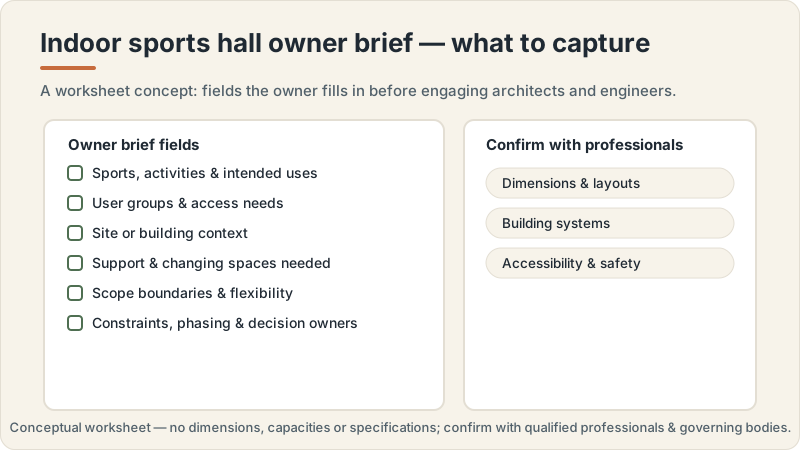
Indoor sports hall owner brief worksheet concept
Conceptual editorial diagram — not a construction drawing, specification, to-scale plan or proof of a real project. It is not engineering, structural, fire/life-safety, crowd-safety or accessibility-compliance guidance. Capacities, dimensions, standards, requirements and costs vary by facility type, audience, site, use case and governing body, and are confirmed with qualified professionals, relevant authorities and governing bodies. Build Design Hub does not design, build, inspect, certify, recommend or match anyone.
What this guide helps you prepare
This guide helps you assemble the owner-side inputs for a school sports hall before you engage designers, engineers or authorities. That means writing down the curriculum activities the hall must support, the community and club uses you hope to accommodate, the timetable pressures that shape who uses the space and when, and the constraints of your site, budget process and governance. The output is a structured brief and a set of questions, not a design and not a decision on any technical matter.
A strong brief lets qualified professionals understand your intent quickly and lets relevant authorities and governing bodies tell you what applies to your situation. It does not answer questions about dimensions, capacities, systems, safety, accessibility, permits or costs. Those depend on your location, facility type, use case, governing body, owner, site, authority, professional team and project scope, and must be confirmed with qualified professionals. Use this preparation to arrive at those conversations organised rather than to reach conclusions on your own.
- Record the primary purpose of the hall in plain language: curriculum PE, community hire, club training, events or a mix.
- List the stakeholder groups whose needs the brief should capture, from pupils and staff to clubs and neighbours.
- Note the governance and approval steps in your organisation so decision points are clear from the start.
- Capture what you already know about the site, existing buildings and access without assuming what will be feasible.
- Distinguish owner decisions (goals, priorities, budget process) from professional decisions (systems, sizing, compliance).
- Keep a running list of open questions to route to professionals, authorities and governing bodies rather than resolving them yourself.
Turning curriculum, community and timetable goals into a brief
The heart of a school sports hall brief is a clear statement of what the space is meant to do and for whom. Curriculum goals describe the physical-education and wider school activities the hall should host across the school day; community-use goals describe evening, weekend and holiday hire by clubs, groups or the public; and timetable goals describe how these overlapping demands share a single space over a week and a year. Writing these as intentions, rather than as a fixed schedule of numbers, keeps the brief honest about what is a goal and what still needs professional and stakeholder input to confirm.
As you draft, separate what you want to achieve from how it might be achieved. It is the owner's role to say that curriculum and community use both matter and to describe the pattern of demand you anticipate; it is not the owner's role to decide the size, layout, systems or capacity that would follow, since those depend on your location, facility type, use case, governing body, site, authority, professional team and project scope and must be confirmed with qualified professionals. A brief that stays at the level of goals, priorities and constraints gives designers and authorities room to advise, rather than boxing them into assumptions.
- Describe the range of curriculum activities the hall is intended to support during the school day.
- Describe the community, club and public uses you hope the hall will accommodate outside school hours.
- Sketch the weekly and seasonal pattern of demand as goals to discuss, not as a committed timetable.
- Note where curriculum use and community use may conflict, and which takes priority in your intent.
- Record flexibility you would value (multi-purpose use, dividing spaces, storage) as goals for professionals to interpret.
- Flag any usage-demand assumptions clearly as unverified, to be tested with stakeholders and professionals rather than stated as fact.
Identifying the professionals and authorities to involve
A school sports hall touches many disciplines and oversight bodies, and part of good preparation is mapping who you may need to involve rather than trying to answer their questions yourself. Depending on your project this can include architects and structural, mechanical, electrical, acoustic, lighting, fire-safety and accessibility professionals, alongside planning, building-control and other authorities, education bodies, and the governing bodies for the sports you intend to host. Build Design Hub does not recommend, rank, verify, introduce, broker or match any of these; the aim here is only to help you recognise the roles and prepare good questions for them.
For each discipline, note what you would want to ask and what documentation you would want to request, and let the professional or authority tell you what applies. Requirements vary by location, facility type, use case, governing body, owner, site, authority, professional team and project scope, so treat every technical, regulatory, accessibility or safety matter as something to confirm with the appropriate qualified professional or authority. Keeping a simple register of roles, contacts, open questions and outstanding documents helps you coordinate the many voices a school sports hall project involves.
- List the design and engineering disciplines your project may touch, and what you would ask each about.
- Identify the planning, building-control and other authorities whose confirmation you may need to seek.
- Note the education bodies and sport governing bodies relevant to your curriculum and community goals.
- Record who owns which decision so responsibilities are not blurred between owner and professionals.
- Prepare the documentation you would request from each party rather than assuming what they will require.
- Keep an involvement register of roles, open questions and pending confirmations, updated as the project progresses.
Planning questions before speaking with professionals
Before your first professional conversation, work through the questions only you as the owner can answer, because clarity here shapes every later discussion. These are questions of purpose, priority, governance and constraint: what the hall is fundamentally for, which uses matter most when they compete, how decisions are approved in your organisation, and what you already know about the site and your funding process. Answering these does not require any technical knowledge and should not stray into technical territory; it simply gives professionals a clear picture of your intent.
Resist the temptation to pre-decide technical outcomes while preparing. It is easy to write a brief that quietly assumes a size, a capacity, a system or a timeline, but those are professional and authority determinations that depend on your specific circumstances and must be confirmed with qualified professionals. Frame anything technical as a question to raise, keep your own answers to the matters you genuinely own, and mark everything else as open. That discipline makes your brief credible and your later conversations far more useful.
- What is the single clearest purpose of this hall, and what are its secondary purposes?
- When curriculum use and community use compete, which takes priority, and who decides?
- What does our internal approval and governance path look like, and where are the decision points?
- What do we genuinely know about the site, access and existing buildings, and what is only assumption?
- How is the project funded and phased in principle, without stating any figures as fixed?
- Which matters are we deliberately leaving open for professionals, authorities and governing bodies to confirm?
Questions for qualified professionals
When you do meet designers, engineers, authorities and governing bodies, come with questions and requests for documentation rather than proposed answers. For building-systems topics such as ventilation, lighting, acoustics, temperature, fire safety and accessibility, keep your questions at the level of what applies to your situation, what the professional recommends, and what records or confirmations they can provide. Do not ask this guide, or yourself, to settle thresholds, sizing, systems or compliance; those belong to the qualified professional and the relevant authority.
Use these meetings to understand scope, process, responsibilities and documentation, and to surface anything that could affect feasibility, phasing or operation. Ask how each professional would want your goals expressed, what they need from you, and what they will confirm in writing. Because requirements vary by location, facility type, use case, governing body, owner, site, authority, professional team and project scope, treat every answer as specific to your project and confirm it with the appropriate qualified professional or authority before you rely on it.
- What applies to a project like ours for this discipline, and where would we confirm it?
- What documentation, drawings or written confirmations can you provide at each stage?
- How would you like our curriculum, community and timetable goals expressed for your work?
- What do you need from us as the owner, and what decisions remain yours versus ours?
- What authorities, governing bodies or specialists should be involved for this aspect, and when?
- What could affect feasibility, phasing, operation or handover that we should be aware of early?
What this does not replace
This is an educational planning resource only. It is not an indoor sports facility construction manual and not structural or architectural design, HVAC/ventilation, lighting or acoustic engineering, fire or life-safety, or accessibility-compliance advice, and it is not permit, zoning, inspection, certification, legal, tax, insurance or procurement advice. It does not design, build, engineer, specify, size, certify, inspect or approve anything, gives no capacities, dimensions, clearances, lux, air-change rates, acoustic or temperature thresholds, revenue, ROI or costs, and offers no warranty interpretation or estimate. Requirements, standards, capacities and costs vary by location, facility type, use case, governing body, owner, site, authority, professional team and project scope, and are confirmed with qualified professionals, relevant authorities and governing bodies.
Build Design Hub does not design, build, engineer, inspect, certify, recommend, rank, verify, introduce, broker or match suppliers, contractors, consultants or professionals, and HELPERG LLC is publisher/operator only. Use this resource to prepare your own thinking and briefs, then have the qualified professionals you engage directly — architects, structural and building-services engineers, lighting, acoustic, accessibility and fire/life-safety specialists, and legal or procurement advisors where appropriate — review your project. Decisions about design, engineering, systems, safety, accessibility, compliance, capacity, procurement and cost must rest on those professionals, the relevant authorities and the governing bodies for your sport and location.
- Not an indoor sports facility construction manual and not structural or architectural design
- Not HVAC/ventilation, lighting or acoustic engineering, fire/life-safety or accessibility-compliance advice
- Not permit/zoning, inspection, certification, warranty-interpretation, legal, tax, insurance or procurement advice
- Not a supplier, contractor, consultant or professional recommendation, ranking, directory or matching service
- Not an estimate and gives no capacity, dimension, system-performance, revenue, ROI or cost figures — requirements and costs vary
- Qualified professional review is required before any indoor sports facility project decision
School sports hall brief and involvement worksheet
- 1Record the primary and secondary purposes of the hall in plain language.
- 2List the curriculum activities the hall is intended to support during school hours.
- 3List the community, club and public uses you hope to accommodate outside school hours.
- 4Describe the anticipated weekly and seasonal pattern of demand as goals, not commitments.
- 5Note where curriculum and community use may conflict, and your intended priority order.
- 6Capture what is genuinely known about the site, access and existing buildings, separating fact from assumption.
- 7Document your internal governance, approval path and key decision points.
- 8Note in principle how the project is funded and phased, without stating figures as fixed.
- 9Map the design, engineering and specialist disciplines your project may need to involve.
- 10List the planning, building-control and other authorities you may need to consult.
- 11Identify the education bodies and sport governing bodies relevant to your goals.
- 12Prepare the questions and documentation requests you would bring to each professional or authority.
- 13Maintain a register of open technical, regulatory, accessibility and safety questions to confirm with professionals.
- 14Keep an involvement log of roles, contacts, decisions owned and confirmations still outstanding.
Common mistakes to avoid
- Writing a brief that states a size, capacity or dimension as fixed, when these must be confirmed with qualified professionals for your specific project.
- Assuming requirements are the same as another school or facility, rather than confirming what applies to your location, site and use case.
- Treating a ventilation, lighting, acoustic or safety decision as the owner's to make instead of a professional's.
- Committing to a timetable or usage-demand figure as fact before stakeholders and professionals have tested it.
- Deciding accessibility or fire-safety outcomes internally rather than routing them to qualified professionals and the relevant authorities.
- Skipping early professional and authority input and only involving them after key intentions have hardened.
- Blurring which decisions the owner owns and which belong to professionals, so responsibilities and open questions get lost.
- Assuming permit, code or governing-body outcomes are certain rather than treating them as matters to confirm.
When to involve a professional
- When your goals begin to imply size, capacity, layout or systems, involve qualified design and engineering professionals to advise.
- When any building-systems topic arises (ventilation, lighting, acoustics, temperature, fire safety, accessibility), involve the relevant qualified professional rather than deciding internally.
- When you need to know what planning, building-control or other authority requirements apply to your site and use case.
- When curriculum, education-body or sport governing-body standards may bear on your intended activities.
- When funding, phasing or approval decisions depend on scope or feasibility that only professionals can assess.
- Whenever a question touches compliance, certification, inspection, permits or legal, tax or insurance matters, involve the appropriate qualified professional or authority.
Frequently asked questions
Questions readers ask about this topic
Does Build Design Hub design, build or engineer the sports hall, or its ventilation, lighting or acoustics?
No. Build Design Hub is an educational resource and does not design, build, engineer, inspect or certify anything, and it does not design HVAC, lighting or acoustic systems. It does not recommend, rank, verify or match suppliers, contractors or professionals, and it provides no capacities, dimensions, costs or requirements. All technical and regulatory matters must be confirmed with qualified professionals and the relevant authorities for your project.
Can this guide tell me how big the hall should be or how many people it can hold?
No. This guide states no dimensions, capacities, clearances or figures, because those depend on your location, facility type, use case, governing body, owner, site, authority, professional team and project scope. Use the guide to prepare your goals and questions, then confirm every such matter with qualified professionals.
How do I frame curriculum and community-use goals without overstepping?
Describe what you want the hall to do and for whom as intentions and priorities, and mark anything technical as an open question. Keep your own answers to owner matters such as purpose, priority, governance and constraint, and leave sizing, systems, capacity and compliance for qualified professionals and authorities to determine.
Who should I involve, and does the guide recommend specific firms?
The guide helps you recognise the disciplines and authorities a school sports hall may involve, such as designers, engineers, planning and building-control authorities and sport governing bodies. It does not recommend, rank, introduce or match any specific firm or professional; sourcing and selecting them is your responsibility and should be done with appropriate advice.
Keep reading