
Who this guide is for
- Owners and boards commissioning a new or converted indoor sports facility who need a written starting point
- Sports clubs and community organisations scoping a hall, gym, or training space before approaching professionals
- Schools and education bodies preparing a brief for a sports hall or multi-purpose indoor space
- Municipalities and public-sector project sponsors framing goals and constraints for a shared facility
- Developers and project teams assembling an owner's brief to hand to architects and engineers
- Facility managers gathering intended-use and operational context to inform an upcoming project
Planning diagram
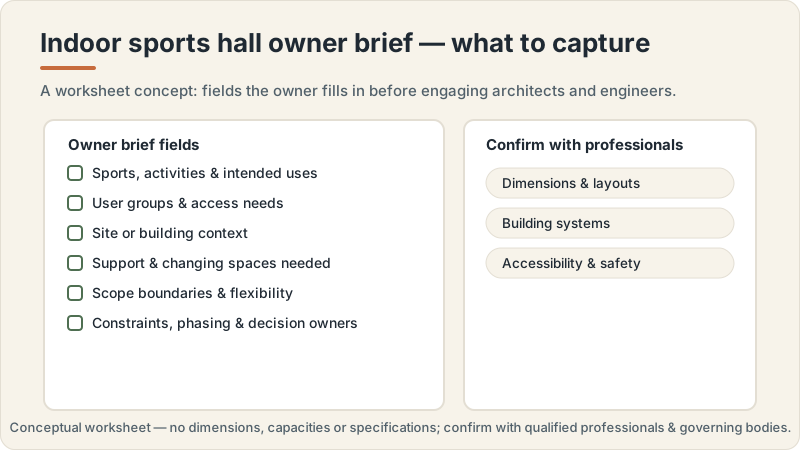
Indoor sports hall owner brief worksheet concept
Conceptual editorial diagram — not a construction drawing, specification, to-scale plan or proof of a real project. It is not engineering, structural, fire/life-safety, crowd-safety or accessibility-compliance guidance. Capacities, dimensions, standards, requirements and costs vary by facility type, audience, site, use case and governing body, and are confirmed with qualified professionals, relevant authorities and governing bodies. Build Design Hub does not design, build, inspect, certify, recommend or match anyone.
What this guide helps you prepare
This guide helps you assemble a written project brief for an indoor sports facility before you engage any design or engineering professionals. A brief is the owner's document: it records why the project exists, what it must achieve, who it serves, and what is in and out of scope. It is not a design and it is not a specification. Its purpose is to give the eventual professional team a clear, honest picture of your intentions and constraints so their questions and proposals can respond to your actual situation rather than to assumptions.
Working through the prompts here helps you separate the decisions that are genuinely yours as owner, such as goals, priorities, budget envelope ownership, and acceptable trade-offs, from the technical decisions that belong to qualified professionals, such as structure, ventilation, lighting, acoustics, and life-safety. Keeping that line clear early prevents you from writing requirements you are not positioned to set, and it makes later conversations with architects, engineers, and authorities more productive. Everything technical stays framed as a question to confirm with the right professional or authority.
- Capture the project's core purpose in a sentence or two you can repeat consistently to stakeholders
- Distinguish owner decisions (goals, priorities, trade-offs) from professional and authority decisions (systems, compliance)
- Record what you know, what you assume, and what you still need to confirm with qualified professionals
- Note the governing bodies or authorities whose requirements may apply, to raise with your professional team
- Prepare questions rather than answers for anything involving dimensions, capacities, systems, or compliance
- Create a shareable document that a professional team can respond to and refine
Defining goals, intended sports, uses, and users
Start by writing down what the facility is for in plain terms. List the sports and activities you intend it to support, and note which are primary and which are occasional or aspirational. A space intended chiefly for one indoor court behaves very differently in planning terms from a multi-purpose hall meant to rotate between several sports, community events, and school use. Whether any given combination of uses is feasible in one space, and what that implies technically, is a question for qualified professionals and the relevant governing bodies, not something to fix in the brief. Record the intent; let the professionals assess feasibility.
Then describe the users. Consider who will be in the building and when: age groups, skill levels, spectators, staff, and any groups with particular needs. Note peak and quiet periods you anticipate and how different user groups might overlap or conflict, such as school hours versus evening club bookings. Avoid stating usage-demand numbers, capacities, or occupancy as facts; frame them as expectations to test with professionals and, where relevant, authorities. The goal is a rich description of intended use that a professional team can interrogate, not a set of technical targets you have pre-decided.
- Which sports and activities are primary, secondary, or aspirational for the space
- Which uses beyond sport (events, school, community, storage) the facility should accommodate
- Which user groups will use the facility, and their broad characteristics and needs
- When peak, shoulder, and quiet usage periods are expected, and where user groups may overlap
- Which governing bodies or sport-specific standards you believe may apply, to confirm with professionals
- What must be possible on day one versus what could be a later phase
Site context, scope boundaries, and constraints
A brief is stronger when it describes the site and the edges of the project honestly. Note whether this is a new build, an extension, or a conversion of an existing space, and gather what you already know about the site: location, access, surrounding uses, and any documents, surveys, or reports already in hand. You do not need to interpret those documents technically; the point is to know what exists so your professional team can request or assess it. Record open questions about the site as questions, and expect that many will only be answered by qualified professionals and relevant authorities during later stages.
Scope boundaries matter as much as goals. Write down what the project explicitly includes and, just as importantly, what it excludes, such as changing rooms, support spaces, spectator areas, parking, or external works. Capture constraints that are real for you: an overall budget envelope you own as a decision, timing pressures, phasing preferences, or fixed site conditions. Do not translate constraints into technical requirements, dimensions, or costs stated as facts. Also record who owns each major decision, because clarity on decision ownership prevents delay and confusion once professionals are engaged.
- Whether the project is new build, extension, or conversion, and what site information already exists
- What is explicitly in scope and what is explicitly excluded from this project
- Which constraints are fixed (site, timing, budget envelope) versus flexible or still open
- What existing documents, surveys, or reports you hold, to make available to your professional team
- Who owns each major decision, and who must be consulted or must approve
- Which site or context questions you cannot answer yourself and must route to professionals or authorities
Planning questions before speaking with professionals
Before you approach architects, engineers, or other professionals, work through the questions you can answer yourself and identify the ones you cannot. Owner-side questions concern purpose, priorities, users, scope, decision ownership, and the trade-offs you are and are not willing to make. Getting these clear first means the professional conversation can focus on feasibility, options, and technical matters rather than on basic direction. It also helps you notice where you have been assuming a technical answer, such as a size, capacity, or system choice, that you are not actually positioned to set.
As you prepare, separate what belongs in your brief from what belongs to the professional team. Anything involving structure, ventilation, lighting, acoustics, fire and life-safety, accessibility, dimensions, clearances, or compliance is a question to confirm with qualified professionals and the relevant authorities, because requirements vary by location, facility type, use case, governing body, owner, site, authority, professional team, and project scope. Write those down as questions to raise, not as decisions to record.
- Can we state the project's purpose and top priorities in a way every stakeholder agrees on?
- Have we listed intended sports, uses, and users without pre-deciding technical answers?
- Do we know what is in and out of scope, and have we written the exclusions down?
- Have we identified which decisions are ours and which belong to professionals or authorities?
- Have we separated confirmed facts from assumptions we still need to test?
- Have we gathered the site information and existing documents a professional team may need?
Questions for qualified professionals
Once your brief is drafted, the next step is a structured conversation with qualified professionals such as architects, engineers, and other specialists, alongside the relevant authorities and governing bodies. Rather than arriving with technical answers, arrive with your brief and a list of questions. For building-systems topics, keep your questions at the level of what to ask and what documentation to request, and let the professional determine calculations, thresholds, sizing, and compliance. Ask them to identify which requirements and standards apply to your specific facility, use case, and location, since these vary and cannot be assumed.
Use the professional conversation to test your brief against reality. Ask what is feasible for your intended uses, what your goals imply for the site, and which of your assumptions need revisiting. Ask what studies, surveys, or approvals the project will need and who is responsible for each. Request that anything they tell you about requirements, capacities, dimensions, or compliance be documented, and confirm which authority or governing body is the ultimate source for each point. The aim is to leave with a clearer, professionally informed picture, not with numbers you have set yourself.
- Which requirements, standards, and governing-body rules apply to our specific facility, uses, and location?
- Given our intended sports and users, what feasibility questions should we resolve first?
- What surveys, studies, or specialist input will this project need, and who is responsible for each?
- What documentation should we request and retain covering systems, compliance, and approvals?
- Which of our brief's assumptions do you consider unrealistic or in need of revision?
- Who among the professional team or authorities is the definitive source for each technical decision?
What this does not replace
This is an educational planning resource only. It is not an indoor sports facility construction manual and not structural or architectural design, HVAC/ventilation, lighting or acoustic engineering, fire or life-safety, or accessibility-compliance advice, and it is not permit, zoning, inspection, certification, legal, tax, insurance or procurement advice. It does not design, build, engineer, specify, size, certify, inspect or approve anything, gives no capacities, dimensions, clearances, lux, air-change rates, acoustic or temperature thresholds, revenue, ROI or costs, and offers no warranty interpretation or estimate. Requirements, standards, capacities and costs vary by location, facility type, use case, governing body, owner, site, authority, professional team and project scope, and are confirmed with qualified professionals, relevant authorities and governing bodies.
Build Design Hub does not design, build, engineer, inspect, certify, recommend, rank, verify, introduce, broker or match suppliers, contractors, consultants or professionals, and HELPERG LLC is publisher/operator only. Use this resource to prepare your own thinking and briefs, then have the qualified professionals you engage directly — architects, structural and building-services engineers, lighting, acoustic, accessibility and fire/life-safety specialists, and legal or procurement advisors where appropriate — review your project. Decisions about design, engineering, systems, safety, accessibility, compliance, capacity, procurement and cost must rest on those professionals, the relevant authorities and the governing bodies for your sport and location.
- Not an indoor sports facility construction manual and not structural or architectural design
- Not HVAC/ventilation, lighting or acoustic engineering, fire/life-safety or accessibility-compliance advice
- Not permit/zoning, inspection, certification, warranty-interpretation, legal, tax, insurance or procurement advice
- Not a supplier, contractor, consultant or professional recommendation, ranking, directory or matching service
- Not an estimate and gives no capacity, dimension, system-performance, revenue, ROI or cost figures — requirements and costs vary
- Qualified professional review is required before any indoor sports facility project decision
Indoor sports facility project brief worksheet
- 1Record the project's core purpose in one or two clear sentences all stakeholders accept
- 2List intended sports and activities, marking each as primary, secondary, or aspirational
- 3Note non-sport uses the facility should support (events, school, community, storage)
- 4Describe the user groups, their broad characteristics, and any particular needs
- 5Capture expected peak, shoulder, and quiet usage periods as expectations, not fixed numbers
- 6Note whether the project is new build, extension, or conversion
- 7Gather and list existing site documents, surveys, and reports already held
- 8Write down what is explicitly in scope and what is explicitly excluded
- 9Record real constraints (timing, phasing, budget envelope you own) without stating technical figures as facts
- 10Identify who owns each major decision and who must approve or be consulted
- 11List the governing bodies and authorities you believe may apply, to confirm with professionals
- 12Separate confirmed facts from assumptions still needing professional or authority confirmation
- 13Draft the questions you will ask qualified professionals, keeping systems topics at ask-and-request level
- 14Note which documents you will request from professionals covering requirements, compliance, and approvals
Common mistakes to avoid
- Stating a dimension, capacity, clearance, or occupancy figure in the brief as if it were fixed, rather than a question for professionals
- Assuming that requirements or standards from one location, sport, or facility type apply to yours without confirmation
- Writing system decisions (ventilation, lighting, acoustics, structure) into the brief as owner choices when they belong to qualified professionals
- Skipping a written brief entirely and relying on verbal intentions that stakeholders remember differently
- Leaving scope boundaries and exclusions undefined, so changing rooms, support spaces, or external works become surprise scope later
- Not identifying who owns each decision, causing delays once professionals and authorities are engaged
- Stating a budget, cost, timeline, or usage-demand assumption as a fact instead of an owner-set envelope or expectation to test
- Treating the brief as final and skipping professional review of feasibility, requirements, and assumptions
When to involve a professional
- When your intended uses, users, or site conditions raise any question about feasibility, structure, or systems, involve qualified professionals early
- When any topic touches ventilation, lighting, acoustics, fire and life-safety, or accessibility, defer to the relevant professional and authorities rather than deciding in the brief
- When you need to know which requirements, standards, or governing-body rules apply to your specific facility and location
- When existing site documents, surveys, or conditions need technical interpretation you are not positioned to give
- Before committing to scope, phasing, or a budget envelope, so professional input can test your assumptions
- When any permit, approval, certification, or compliance question arises, route it to qualified professionals and the relevant authority
Frequently asked questions
Questions readers ask about this topic
Does Build Design Hub design, build, or engineer indoor sports facilities?
No. Build Design Hub is an educational resource only. It does not design, build, engineer, inspect, certify, or project-manage, and it does not design HVAC, lighting, or acoustic systems. It does not recommend, rank, verify, or match suppliers, contractors, or professionals, and it gives no capacities, dimensions, costs, or requirements. This guide only helps you prepare a written brief to discuss with qualified professionals and the relevant authorities.
Why does this guide avoid giving dimensions, capacities, or requirements?
Because they genuinely vary. Requirements for indoor sports facilities depend on location, facility type, use case, governing body, owner, site, authority, professional team, and project scope. Any figure stated as universal would risk being wrong for your situation. This guide frames such matters as questions to confirm with qualified professionals, relevant authorities, and governing bodies.
What is the difference between an owner's brief and a design?
An owner's brief records goals, intended uses, users, scope, constraints, and decision ownership. A design translates those intentions into technical solutions and is the work of qualified professionals such as architects and engineers. Keeping the brief at the level of intent, and leaving technical answers to professionals, is exactly the separation this guide is built around.
When should I involve professionals in the process?
As soon as your brief touches anything technical, feasibility-related, or compliance-related, which is early for most projects. Use the brief to organise your goals and questions, then engage qualified professionals and the relevant authorities to test feasibility, identify applicable requirements, and provide the documentation and approvals your project will need.
Keep reading